 Political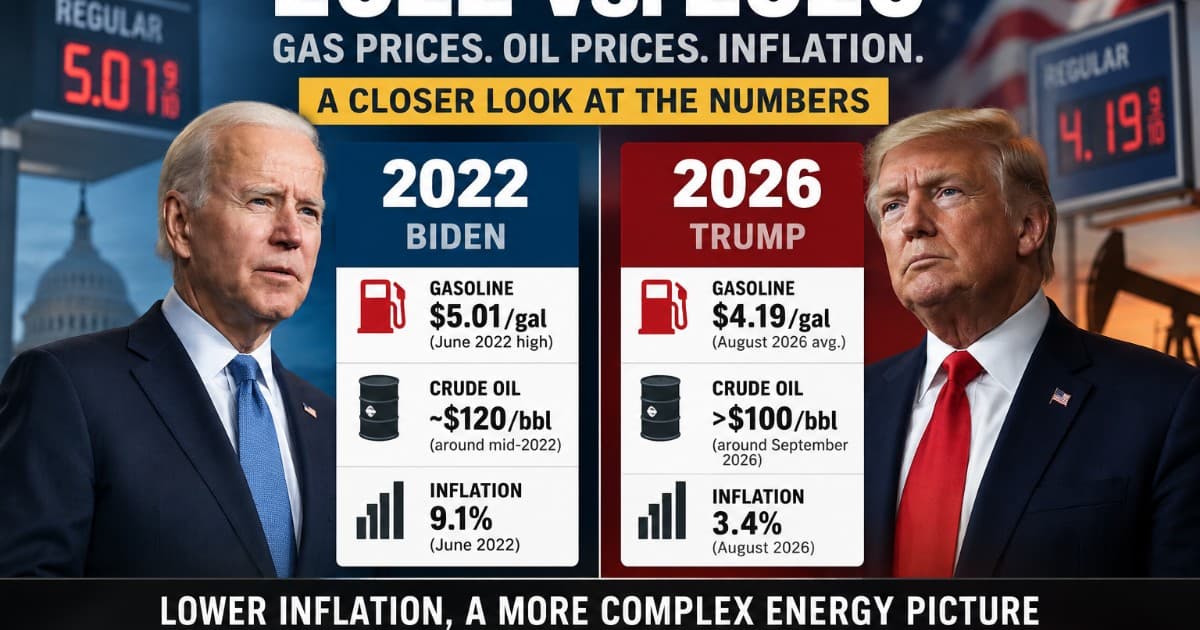
Political
2022 vs. 2026: What the Numbers Really Show About Gas Prices, Oil and Inflation
By The Daily Ledger1 min read11 views
A viral comparison contrasts the U.S. economy under Joe Biden in 2022 with conditions under Donald Trump in 2026. Some of the figures are broadly accurate, but the full picture is more complicated — especially when it comes to gasoline and oil prices.
A social media post comparing economic conditions in 2022 and 2026 is drawing attention by highlighting gasoline prices, crude oil and inflation under Joe Biden and Donald Trump.
In June 2022, U.S. gasoline prices did briefly climb above $5 per gallon nationally. The U.S. Energy Information Administration says regular gasoline reached a 2022 high of about $5.01 per gallon in June.
Inflation was also exceptionally high. According to the Bureau of Labor Statistics, annual consumer inflation reached 9.1% in June 2022 — the highest 12-month increase since 1981.
By August 2026, annual inflation had fallen substantially to 3.4%. That means consumer prices were still increasing overall, but at a much slower annual rate than during the 2022 inflation peak.
However, the viral comparison needs an important correction on energy prices.
Federal data show gasoline averaged about $4.19 per gallon in August 2026, while oil prices climbed back above $100 per barrel around September. That means a simple graphic showing roughly $80 oil for August 2026 does not fully represent conditions throughout the period.
Gasoline prices also rose 3.9% in August alone, and were 27.4% higher than a year earlier.
The comparison also does not prove that either president personally caused the changes. Gasoline, oil and inflation are affected by global energy markets, wars, refinery capacity, supply and demand, Federal Reserve policy, taxes, tariffs and government policy.
Another important distinction is that lower inflation does not mean prices have returned to their previous levels. Inflation falling from 9.1% to 3.4% means prices are rising more slowly — not that the cumulative price increases of previous years have disappeared.
The numbers therefore show a real decline in the inflation rate compared with the 2022 peak, while the energy-price picture in 2026 is more complicated than the viral comparison suggests.


Comments (0)
No comments yet. Be the first to share your thoughts.
Leave a comment
Comments are reviewed before they appear.