 World
World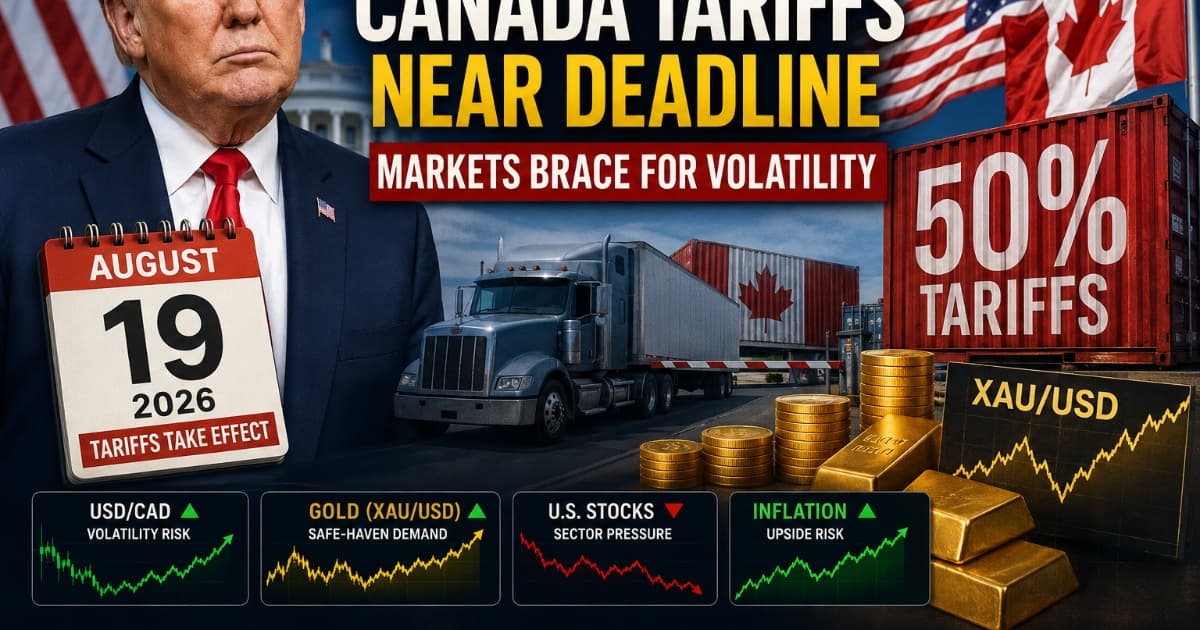
World
Trump’s 50% Canada Tariffs Near Deadline as Markets Brace for Volatility
By The Daily Ledger6 min read25 views
President Donald Trump’s planned 50% tariffs on certain Canadian imports are set to take effect August 19, putting traders on alert as U.S.-Canada negotiations continue and markets assess the potential impact on currencies, stocks, inflation and gold.
Trump’s 50% Canada Tariffs Near Deadline as Markets Brace for Volatility
President Donald Trump’s latest trade confrontation with Canada is approaching a critical deadline, giving financial markets another potentially significant catalyst to monitor.
The Trump administration has announced additional 50% tariffs on specified Canadian imports, with the measures scheduled to take effect at 12:01 a.m. Eastern Time on August 19, 2026.
The White House says the measures are intended to respond to what the administration describes as discriminatory Canadian treatment of U.S. commerce.
The affected categories include certain Canadian dairy, automotive and other products.
With the deadline approaching, negotiations between Washington and Ottawa have become particularly important for traders.
A last-minute agreement could reduce market concerns, while failure to reach a deal could increase uncertainty across currencies, commodities and equities.
Why This Matters for Financial Markets
Tariffs are not simply a political issue.
They can influence inflation, corporate costs, economic growth and central-bank expectations — all of which can move financial markets.
Higher tariffs make affected imported products more expensive.
If businesses pass those additional costs to consumers, inflationary pressure could increase.
That creates an important question for traders:
Could another escalation in Trump’s trade policy change expectations for U.S. inflation and Federal Reserve policy?
The answer could determine how the dollar, Treasury yields, stocks and gold react.
USD/CAD Could Be One of the Most Sensitive Markets
The Canadian dollar is one of the most obvious assets to watch.
Canada and the United States have deeply interconnected economies, meaning a significant deterioration in trade relations could affect Canadian exporters and economic-growth expectations.
If investors believe the tariffs will hurt Canada’s economy more severely, the Canadian dollar could weaken.
That scenario could potentially push USD/CAD higher.
But traders should also consider the opposite scenario.
If Washington and Ottawa announce a compromise, postponement or exemption before implementation, uncertainty could decline quickly.
That could support the Canadian dollar and potentially pressure USD/CAD lower.
The key point is that the August 19 deadline creates event risk in both directions.
What Could Happen to Gold?
Gold traders should also monitor the dispute closely.
Trade conflicts can sometimes increase demand for safe-haven assets because investors become more concerned about economic growth and financial-market instability.
That could potentially support XAU/USD.
However, Trump’s tariff policies can affect gold through several different channels.
If tariffs increase inflation expectations, Treasury yields could rise.
Higher yields can make non-yielding gold comparatively less attractive.
At the same time, if investors move toward safety and the U.S. dollar weakens, gold could receive additional support.
This means traders should avoid assuming:
Trump tariffs = automatic Gold BUY.
Instead, watch the confirmation markets.
Potential bullish confirmation for gold
- U.S. Dollar Index weakens
- Treasury yields fall
- Equity markets turn risk-off
- Safe-haven demand increases
- Gold breaks technical resistance with momentum
Potential bearish confirmation for gold
- U.S. Dollar Index strengthens sharply
- Treasury yields rise
- Inflation expectations increase
- Markets treat the tariffs as manageable
- Gold fails at resistance
Gold’s reaction to the surrounding markets will therefore be more important than the tariff headline alone.
Stocks Could Face Sector-Specific Pressure
The impact on U.S. equities may also be complicated.
Companies competing against Canadian imports could potentially benefit from additional protection.
Companies relying on Canadian materials, components or supply chains, however, could face higher costs.
Automotive companies deserve particular attention because the administration’s measures include certain Canadian motor-vehicle products.
Agriculture and other cross-border industries may also experience volatility.
For the broader S&P 500 and Nasdaq, traders should monitor whether the dispute remains contained or develops into a larger deterioration in U.S.-Canada trade relations.
A broader escalation would likely create more significant risk for equity markets.
Inflation Is the Bigger Question
One of the most important longer-term issues is inflation.
Tariffs effectively increase the cost of importing affected products.
The critical question is who ultimately absorbs that cost.
Importers can accept lower profit margins, foreign producers can reduce prices, or companies can pass some of the additional cost to consumers.
If consumer prices rise materially, traders could reassess expectations for Federal Reserve monetary policy.
That matters because Fed expectations influence nearly every major asset class.
A more hawkish interest-rate outlook can strengthen the dollar and pressure gold.
A weaker economic outlook combined with lower rate expectations could have the opposite effect.
Markets Are Already Watching the Federal Reserve
Gold entered August 17 with support from a weaker U.S. dollar and reduced expectations for a September Federal Reserve rate increase.
That makes the interaction between tariffs, inflation and Fed expectations particularly important.
If tariff developments substantially change inflation expectations, traders could quickly reprice the expected path of U.S. interest rates.
Gold traders should therefore monitor the tariff story alongside economic data rather than analyzing it in isolation.
What Traders Should Watch Before August 19
Several developments could determine the market reaction.
First is any announcement from President Trump or the White House regarding implementation.
Second is the progress of negotiations between U.S. and Canadian officials.
Third is Canada’s response.
Traders should also monitor:
- USD/CAD
- U.S. Dollar Index (DXY)
- XAU/USD
- U.S. Treasury yields
- S&P 500 futures
- Nasdaq futures
- Automotive stocks
- Agricultural companies
- Inflation expectations
These markets can provide confirmation of how institutional investors are interpreting the political developments.
Trading Outlook
The August 19 deadline creates the possibility of increased volatility.
But traders should be careful about predicting direction solely from Trump’s announcement.
If the tariffs take effect and markets interpret them as a serious escalation in global trade risk, safe-haven demand could increase.
That environment could support gold, particularly if the dollar and Treasury yields decline.
If markets instead focus on higher inflation and potentially tighter Federal Reserve policy, yields and the dollar could strengthen, creating pressure on gold.
And if Trump and Canadian officials reach an agreement before implementation, some of the risk premium could disappear rapidly.
For that reason, the highest-quality trading signal may come after markets reveal their reaction, rather than immediately after the political headline.
Bottom Line
Trump’s 50% tariffs on specified Canadian imports are scheduled to take effect on August 19, making the next several days important for traders.
The direct focus will be U.S.-Canada trade relations, but the consequences could extend much further.
USD/CAD, gold, the U.S. dollar, Treasury yields and U.S. equities are among the key markets to watch.
For gold traders especially, the most important confirmation will come from the relationship between risk sentiment, DXY and Treasury yields.
The headline may trigger volatility.
The reaction across those markets should help determine the direction.
This article is for informational purposes only and does not constitute financial or investment advice.
#Policy

Comments (0)
No comments yet. Be the first to share your thoughts.
Leave a comment
Comments are reviewed before they appear.