 World
World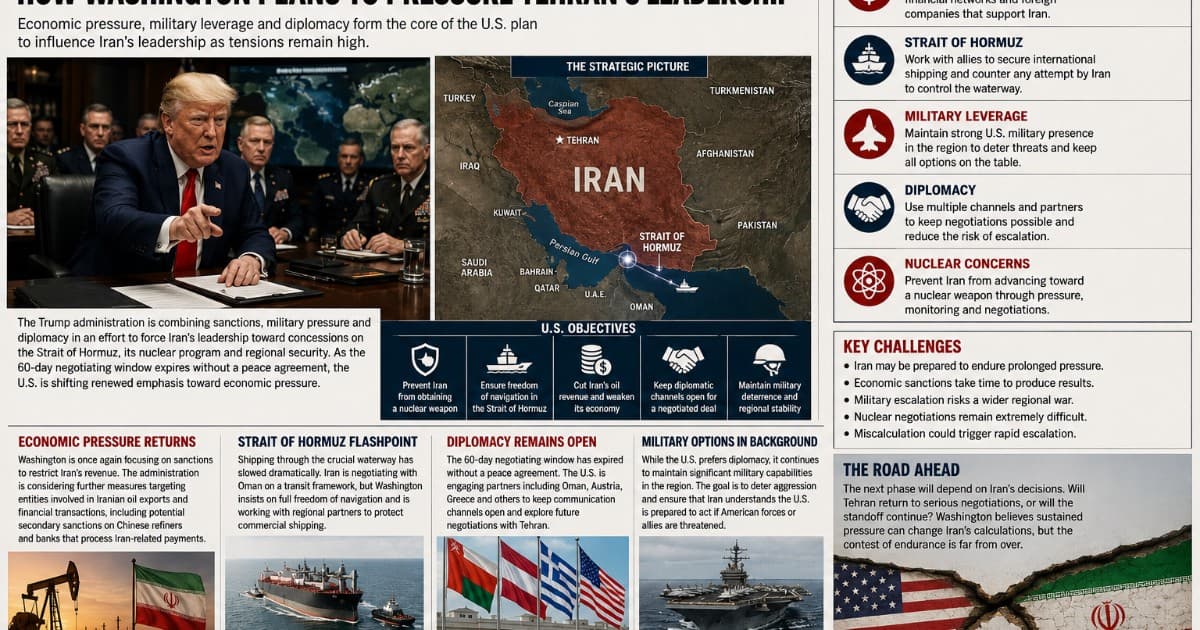
World
Inside Trump’s Iran Strategy: How Washington Plans to Pressure Tehran’s Leadership
By The Daily Ledger10 min read24 views
The Trump administration is combining sanctions, military pressure and diplomacy in an effort to force Iran’s leadership toward concessions on the Strait of Hormuz, its nuclear program and regional security as the U.S.-Iran confrontation enters a critical new phase.
Inside Trump’s Iran Strategy: How Washington Plans to Pressure Tehran’s Leadership
The Trump administration is entering a decisive phase in its confrontation with Iran, attempting to combine economic pressure, military leverage and renewed diplomacy to influence Tehran's leadership without allowing the conflict to spiral further out of control.
As of August 17, 2026, the United States and Iran have failed to convert a temporary diplomatic framework into a lasting peace agreement.
The 60-day negotiating period established earlier this summer has expired without resolution.
At the same time, shipping through the Strait of Hormuz remains severely disrupted, Iran's nuclear program remains unresolved and Washington is again turning heavily toward economic pressure.
Taken together, these developments reveal an American strategy built around several interconnected objectives rather than a single course of action.
Washington's Central Objective
At the heart of U.S. policy is an attempt to change the calculations of Iran's leadership.
Washington wants Tehran to conclude that continued confrontation will ultimately cost more than negotiation.
That does not necessarily mean the United States expects economic pressure or military force alone to produce an immediate political transformation inside Iran.
Instead, the strategy appears designed to gradually reduce Tehran's options.
The administration is trying to pressure Iran economically, restrict its ability to generate revenue, maintain military leverage, preserve diplomatic channels and increase the costs associated with keeping the Strait of Hormuz disrupted.
The intended result is leverage.
Washington hopes that enough pressure will eventually convince Iranian decision-makers that accepting a negotiated settlement is preferable to continuing the confrontation.
Pillar One: Economic Pressure
Economic pressure has returned to the center of Trump's Iran strategy.
After months in which military operations and diplomatic negotiations dominated the confrontation, the administration is again emphasizing sanctions.
The objective is to weaken the financial resources available to Tehran.
Iran depends heavily on energy exports and access to international financial networks.
By restricting those channels, Washington hopes to make sustaining prolonged confrontation increasingly expensive.
Potential measures include stronger enforcement of existing sanctions and additional restrictions targeting businesses involved in Iranian energy exports.
Washington could also increase pressure on foreign companies and financial institutions facilitating transactions with Tehran.
The strategic calculation is straightforward:
If Iran's leadership faces worsening economic conditions, declining revenue and growing difficulty financing state operations, Washington believes pressure for a negotiated settlement could increase.
Targeting Iran's Oil Revenue
Oil remains particularly important.
Iran's energy exports provide a crucial source of foreign currency.
Restricting those exports therefore gives Washington one of its strongest economic pressure points.
The United States can target companies purchasing Iranian crude, shipping networks transporting it and financial institutions processing payments.
China is especially important because Chinese companies have remained significant buyers of Iranian energy.
That creates a potentially difficult decision for Washington.
Aggressively targeting Chinese companies or banks could increase pressure on Tehran, but it could simultaneously create another source of tension between Washington and Beijing.
Trump therefore has to balance maximum pressure against the risk of expanding the confrontation economically.
Pillar Two: The Strait of Hormuz
The Strait of Hormuz has become one of the most important strategic issues in the entire confrontation.
The narrow waterway connects the Persian Gulf to international shipping routes and is essential to global energy transportation.
Iran views the strait as a major source of strategic leverage.
Washington views unrestricted international navigation through the waterway as essential.
That difference has transformed Hormuz into much more than a shipping dispute.
For Tehran, influence over the strait creates leverage over the global economy.
For Washington, allowing Iran to determine when international shipping can pass risks establishing a precedent that gives Tehran enormous geopolitical influence.
The United States therefore wants commercial shipping restored without accepting conditions that effectively recognize Iranian control over international navigation.
Iran-Oman Negotiations Add Another Dimension
Iran has also been negotiating with Oman over arrangements for ship transit through the Strait of Hormuz.
According to reporting on August 17, Tehran says that agreement is approaching completion.
The proposed framework could allow vessels to use designated routes near Iranian and Omani waters during an interim period.
For Washington, however, the important question is whether any such agreement restores sufficiently open international navigation.
An Iran-Oman arrangement could reduce immediate shipping pressure while leaving the larger political dispute unresolved.
That means Washington must evaluate whether to accept an imperfect arrangement, demand additional concessions or continue applying pressure.
Pillar Three: Military Leverage
Military power remains another component of U.S. strategy.
The United States has already demonstrated its willingness to use force during the conflict.
That history gives American diplomatic and economic threats additional weight.
But maintaining military leverage is different from continuously expanding military operations.
Every additional strike creates risks.
Iran could retaliate against American forces, Gulf states, Israel or commercial shipping.
The conflict could expand geographically.
Military operations also consume weapons, aircraft availability, logistical resources and political support.
For that reason, Washington currently appears to be placing greater emphasis on economic pressure while retaining military force as leverage.
The message to Tehran is that negotiations remain possible, but the military option has not disappeared.
Pillar Four: Diplomacy
Despite hostile rhetoric from both sides, Washington has not abandoned diplomacy.
The administration has expanded diplomatic outreach beyond the governments traditionally involved in mediation.
Austria and Greece have recently become part of broader diplomatic activity surrounding the crisis.
Their roles are different.
Austria has particular relevance because Vienna hosts the International Atomic Energy Agency, which plays a central role in monitoring nuclear activities.
Greece has substantial interests in international shipping and maritime security.
Washington's outreach therefore appears designed to create additional diplomatic channels capable of communicating with Tehran when direct negotiations are difficult.
Why Washington Needs Multiple Mediators
U.S.-Iran relations suffer from an enormous trust deficit.
Direct communication can become politically difficult for both governments.
Third countries therefore provide alternative channels.
Oman has historically played an important role in facilitating U.S.-Iran communication.
Qatar, Pakistan and European governments can also provide diplomatic pathways.
Multiple channels give Washington flexibility.
If one negotiating route collapses, another may remain available.
This is especially important during a military confrontation, when misunderstanding can rapidly produce escalation.
Pillar Five: Iran's Nuclear Program
Iran's nuclear capabilities remain a fundamental U.S. concern.
Washington wants to prevent Iran from developing a nuclear weapon.
Military operations can damage physical infrastructure, but they cannot permanently eliminate scientific knowledge.
That creates a long-term strategic problem.
Even successful strikes against nuclear facilities do not automatically produce a durable nuclear settlement.
Ultimately, Washington needs some combination of monitoring, restrictions and political agreements if it wants lasting confidence that Iran will not build a weapon.
That makes diplomacy essential even within a strategy heavily reliant on coercion.
The Leadership Problem
One of Washington's greatest challenges is understanding what will actually influence Iran's leadership.
Economic hardship does not automatically produce political concessions.
Iran has lived under varying degrees of international sanctions for decades.
Its government has developed mechanisms for surviving isolation, including alternative trading networks, subsidies and sanctions-evasion systems.
Iran's leadership may also believe that accepting American demands under pressure would weaken its domestic authority.
That can produce the opposite of what Washington intends.
Instead of encouraging compromise, external pressure can sometimes strengthen hardliners who argue that negotiation with the United States is pointless.
This is one of the central uncertainties surrounding Trump's strategy.
Iran Is Preparing to Endure
Recent reporting suggests Tehran is attempting to reorganize its economy around surviving prolonged confrontation.
That means Iranian leaders may not believe they need an immediate settlement.
If Tehran concludes that it can withstand economic pressure longer than Washington can sustain political, military and economic costs, Iran may choose to wait.
This transforms the confrontation into a test of endurance.
Washington believes economic pressure will eventually force concessions.
Tehran may believe time works in its favor.
Both assumptions cannot be correct indefinitely.
The Risk of Miscalculation
The greatest danger may not be a deliberate decision by either government to begin a larger conflict.
It may be miscalculation.
An attack on a commercial vessel could produce retaliation.
A strike against American personnel could trigger a larger military response.
A misunderstanding regarding shipping movements could escalate rapidly.
Aggressive political rhetoric can further reduce the room leaders have to compromise without appearing weak.
That makes communication channels extremely important even when formal negotiations are stalled.
Pressure Without Regime-Change Assumptions
There is also an important distinction between pressuring Iran's leadership and planning to replace it.
Publicly available evidence supports a strategy focused on coercing changes in Tehran's behavior through sanctions, military leverage and negotiations.
It does not justify treating speculation about secret American plans against individual Iranian leaders as established fact.
Any discussion of internal U.S. operational planning beyond publicly confirmed policy should therefore be treated cautiously.
The observable strategy is pressure on the Iranian state and leadership structure, not proof of a publicly declared plan to install a replacement government.
Trump's Strategic Dilemma
Trump faces a difficult choice.
Escalating military action could increase pressure quickly but risks widening the war.
Relying primarily on sanctions reduces immediate military risk but may take months or years to change Iranian behavior.
Making significant concessions could reopen diplomacy but could also allow Tehran to claim that its strategy succeeded.
Maintaining the current confrontation carries its own costs through energy disruption, military expenditures and political pressure.
There is no simple option.
That explains why Washington is using several instruments simultaneously.
What Washington Is Likely to Watch
The next phase of American planning will depend heavily on Iran's behavior.
U.S. officials will be watching whether commercial shipping through Hormuz begins to normalize.
They will monitor Iranian oil exports and the effectiveness of sanctions.
They will assess Tehran's nuclear activities.
Washington will also watch whether Iran becomes more willing to negotiate as economic pressure increases.
Developments involving American forces or attacks on regional partners could dramatically change the calculation.
What Success Would Look Like for Washington
A successful outcome for the United States would probably require several developments simultaneously.
Commercial shipping through the Strait of Hormuz would return to predictable operation.
Iran would accept enforceable restrictions preventing development of a nuclear weapon.
The risk to American forces and regional partners would decline.
Washington would gain enough confidence to reduce military pressure.
And the two governments would establish some diplomatic mechanism capable of preventing another immediate confrontation.
Achieving all of those objectives would be substantially more difficult than achieving any one of them individually.
The Strategy Could Still Fail
Economic pressure has significant limitations.
Sanctions can damage an economy without necessarily changing government policy.
Military pressure can destroy infrastructure without producing political capitulation.
Diplomacy can fail when neither side believes compromise is preferable to continued confrontation.
Trump's strategy therefore depends on something that cannot be guaranteed: Iranian leaders eventually deciding that negotiation is their least costly option.
If Tehran instead believes it can endure longer than Washington, the confrontation could continue for an extended period.
Bottom Line
The current U.S. strategy toward Iran is best understood as a campaign of combined pressure.
Washington is using economic sanctions to weaken Tehran's financial position.
It is attempting to restore international shipping through the Strait of Hormuz.
It is retaining military power as leverage.
It is keeping diplomatic channels open through multiple countries.
And it continues to focus on preventing Iran from obtaining a nuclear weapon.
The strategy is intended to narrow the choices available to Iran's leadership until negotiation becomes more attractive than continued confrontation.
But Iran is pursuing its own strategy of endurance and leverage.
That creates a contest in which both Washington and Tehran appear to believe time can eventually work in their favor.
With the 60-day negotiating window now ending without a comprehensive peace agreement, the next phase will test whether Trump's combination of sanctions, military leverage and diplomacy can actually change Tehran's calculations — or whether the confrontation will settle into a prolonged and increasingly costly stalemate.
This article reflects publicly available reporting and confirmed policy developments as of August 17, 2026. It distinguishes reported U.S. policy from speculation about undisclosed operational plans.
Comments (0)
No comments yet. Be the first to share your thoughts.
Leave a comment
Comments are reviewed before they appear.