 World
World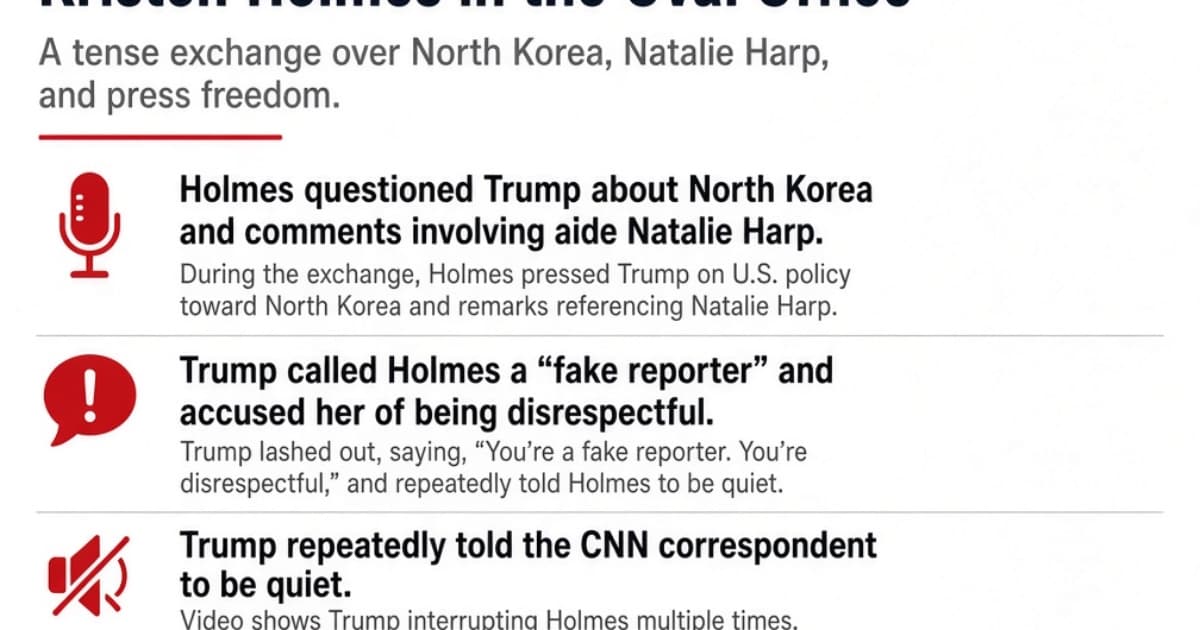
World
White House Escalates Attack on CNN Reporter Kristen Holmes, Bringing Her Children Into Dispute
By The Daily Ledger8 min read35 views
The White House has intensified a clash with CNN correspondent Kristen Holmes after President Donald Trump berated her during an Oval Office exchange. An official White House social-media account later made the confrontation deeply personal by invoking Holmes’ children, prompting criticism and a defense of the reporter from CNN.
White House Escalates Attack on CNN Reporter Kristen Holmes, Bringing Her Children Into Dispute
The White House has escalated an increasingly bitter confrontation with CNN correspondent Kristen Holmes after President Donald Trump lashed out at the journalist during an Oval Office exchange — with an official administration account later bringing Holmes' children into the dispute.
The confrontation began Monday, August 17, when Holmes questioned Trump during a White House event.
Trump reacted angrily to several of her questions, telling the CNN correspondent to be quiet, describing her as a “fake reporter” and accusing her of being disrespectful.
But the dispute did not end when the Oval Office exchange was over.
The White House's Rapid Response social-media operation subsequently published an extraordinary personal attack against Holmes.
The post invoked her children and suggested that they would one day be ashamed of their mother's question.
CNN responded by defending Holmes and arguing that asking difficult questions of the president is a fundamental responsibility of White House journalists.
The episode has now become the latest flashpoint in Trump's long-running confrontation with major news organizations.
What Happened in the Oval Office?
The confrontation occurred during a White House event that was originally intended to honor teenage lifeguard Ryder Williams and a young boy he rescued from dangerous surf in California.
After the ceremony, Trump took questions from reporters.
Holmes attempted to question the president about his administration's approach toward North Korea.
Trump recently ordered a reduction in some joint U.S.-South Korea military exercises, a development that has attracted considerable attention because North Korean leader Kim Jong Un has historically objected to those drills.
Holmes asked Trump whether Kim had requested the reduction.
Trump pushed back on the premise of the question and said Kim had responded to his diplomatic outreach.
The interaction quickly became tense.
Trump accused Holmes of being disrespectful and repeatedly attempted to stop her from continuing.
Trump Tells Holmes to “Be Quiet”
Video of the exchange shows Trump becoming increasingly irritated as Holmes continued asking questions.
The president called her a “fake reporter” and told her to “be quiet.”
Trump has frequently used the term “fake news” when criticizing CNN and other news organizations whose reporting he disputes.
But Holmes continued attempting to ask questions.
The exchange then moved to another politically sensitive subject involving Trump aide Natalie Harp.
The Natalie Harp Question
Holmes asked Trump to respond to criticism from Democratic Sen. Jon Ossoff involving Harp.
Ossoff had publicly criticized Trump while questioning his presidential priorities.
Holmes presented the criticism to Trump and asked for his response.
Trump strongly objected.
The president attacked Ossoff and again criticized Holmes for asking the question.
The White House later argued that the question itself was inappropriate and personally offensive.
That disagreement became the basis for an even more aggressive response online.
White House Rapid Response Account Enters the Fight
After the Oval Office encounter, the White House's Rapid Response account posted about Holmes.
Rather than limiting its response to disputing the substance of her reporting or defending Trump, the account turned its attention to the journalist personally.
It characterized Holmes' question in extremely negative terms and then invoked her family.
The White House post told Holmes that someday her children would encounter what it described as her “disgusting and inhumane question.”
It went on to suggest that they would be “sickened and embarrassed” by their parent.
That language transformed what began as a routine — if contentious — exchange between a president and a reporter into a broader controversy over how the White House treats journalists.
Why Bringing Her Children Into It Drew Attention
Politicians frequently criticize journalists.
Presidents have challenged news organizations throughout American history.
Reporters are also regularly accused of bias by political figures from both parties.
But invoking a journalist's children represents a substantially more personal form of criticism.
Holmes' children were not involved in the Oval Office exchange.
They were not responsible for her question.
And they were not part of the political dispute between Trump, Ossoff or CNN.
That is why the White House post immediately attracted additional attention.
Critics argued that disagreement with a journalist's question could have been addressed without involving her family.
CNN Defends Kristen Holmes
CNN responded strongly to the attacks.
The network defended Holmes as an experienced journalist carrying out her professional responsibilities.
CNN argued that Holmes was asking legitimate questions about matters involving the president and his administration.
White House correspondents routinely question presidents about issues they may not want to discuss.
That adversarial relationship is an intentional feature of political journalism.
Reporters are not expected simply to ask questions that political leaders find comfortable.
CNN's response emphasized that personally attacking journalists does not change the underlying legitimacy of their questions.
A Long-Running Trump-CNN Conflict
The episode fits into a much larger history between Trump and CNN.
Trump has battled with the network since his first presidential campaign.
He has repeatedly called CNN “fake news,” criticized its reporters during press conferences and attacked individual anchors and correspondents.
CNN, meanwhile, has aggressively covered Trump's administration, political campaigns, legal controversies and policy decisions.
The relationship has frequently produced confrontational exchanges at White House events.
Several CNN journalists have previously become targets of Trump's criticism after questioning him.
The Holmes confrontation represents another chapter in that conflict.
Trump's Treatment of Female Reporters Faces Scrutiny
The incident has also renewed scrutiny of Trump's interactions with female journalists.
Trump has had highly publicized confrontations with several prominent women working in the media.
Critics argue that some of his attacks become unusually personal when directed at female reporters.
Trump and his supporters reject accusations that gender drives his criticism, arguing instead that he responds aggressively to journalists he believes are unfair or hostile regardless of who they are.
The debate surrounding Holmes is likely to reinforce those competing interpretations.
The Role of the White House Rapid Response Operation
Another important element of the story is that the attack did not come solely from Trump.
It was amplified by an official White House communications operation.
Rapid-response accounts are designed to react quickly to political criticism, media reports and statements from opponents.
They can distribute the administration's version of events directly to millions of people without relying on traditional news organizations.
That makes them powerful political communication tools.
But it also raises questions about where the line should be drawn between aggressively defending an administration and personally attacking journalists.
In this case, the decision to invoke Holmes' children pushed the controversy beyond the original disagreement over her question.
Why White House Reporters Ask Confrontational Questions
White House journalism has always involved tension.
Presidents possess enormous power.
Reporters assigned to cover them are expected to question how that power is being used.
That means journalists frequently ask about subjects presidents would prefer to avoid.
Questions may involve wars, scandals, advisers, economic problems, political opponents or controversial policy decisions.
Presidents are free to criticize those questions.
They can challenge the premise.
They can refuse to answer.
They can dispute the facts.
But the relationship between the presidency and the press is intentionally adversarial because journalists are expected to hold public officials accountable.
Press Freedom Becomes Part of the Debate
The controversy has therefore expanded beyond Holmes herself.
Media advocates and journalists are debating what the episode says about the relationship between the Trump administration and the press.
Critics fear increasingly personal attacks can intimidate reporters or discourage journalists from asking difficult questions.
Trump's supporters see the issue differently.
They argue that journalists frequently attack Trump personally and that the administration has every right to respond forcefully when it believes coverage is unfair.
Those competing views have defined Trump's relationship with American media for years.
Social Media Changes Presidential Communication
The controversy also illustrates how social media has changed political communication.
In previous administrations, a tense exchange between a president and reporter might have ended when the press conference finished.
Today, the confrontation can continue online for hours or days.
Official accounts can isolate video clips.
Supporters can circulate them.
Opponents can respond.
Journalists can defend their reporting.
Millions of people can then participate in the argument.
The result is that a brief Oval Office interaction can rapidly become a national political controversy.
What Happens Next?
There is no indication that CNN intends to remove Holmes from White House coverage.
The network has publicly supported her.
The White House also shows no indication that it intends to soften its broader criticism of CNN.
That means confrontations between Trump and the network are likely to continue.
The more important question is whether official White House communications will continue making personal attacks involving journalists' families.
That aspect of the Holmes episode has attracted attention precisely because it went beyond criticism of her reporting.
Bottom Line
A tense Oval Office exchange between President Donald Trump and CNN correspondent Kristen Holmes has developed into a wider controversy over the White House's treatment of journalists.
Trump called Holmes a fake reporter, accused her of being disrespectful and repeatedly told her to be quiet as she attempted to question him.
The White House then escalated the confrontation online.
An official Rapid Response account attacked Holmes personally and invoked her children, suggesting they would someday be embarrassed by her question.
CNN defended its correspondent, saying Holmes was doing what White House reporters are supposed to do: ask difficult and relevant questions of the president.
The dispute is now about more than one question.
It has become another test of the increasingly hostile relationship between the Trump administration and the American press — and of how far official political communications should go when responding to journalists.
#Climate
Comments (0)
No comments yet. Be the first to share your thoughts.
Leave a comment
Comments are reviewed before they appear.