 World
World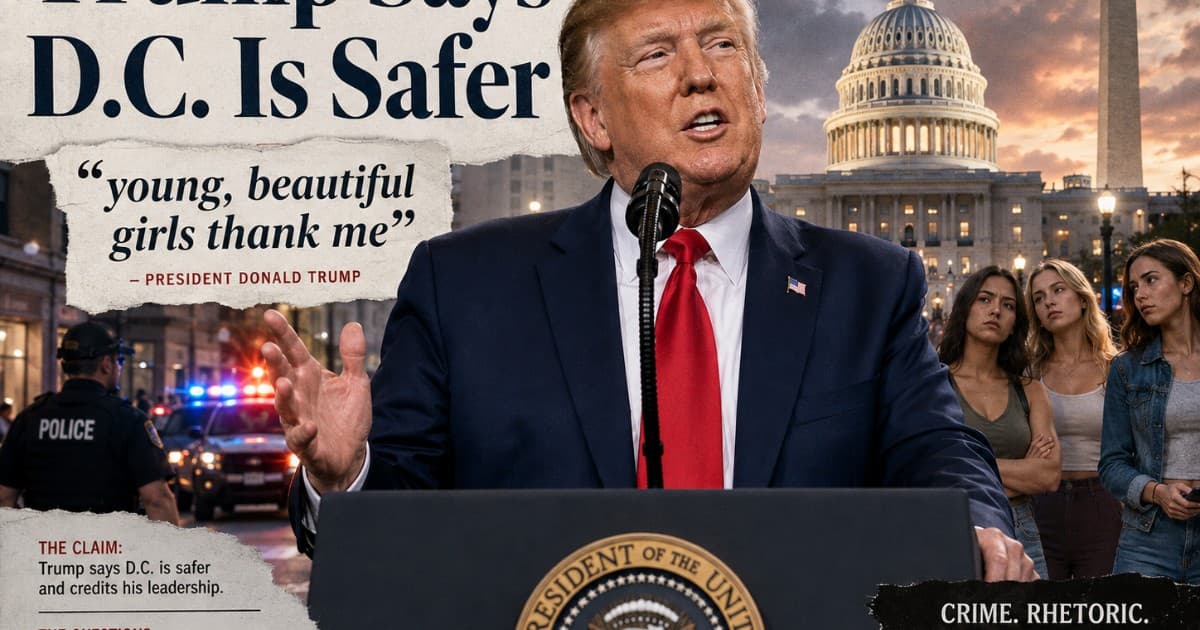
World
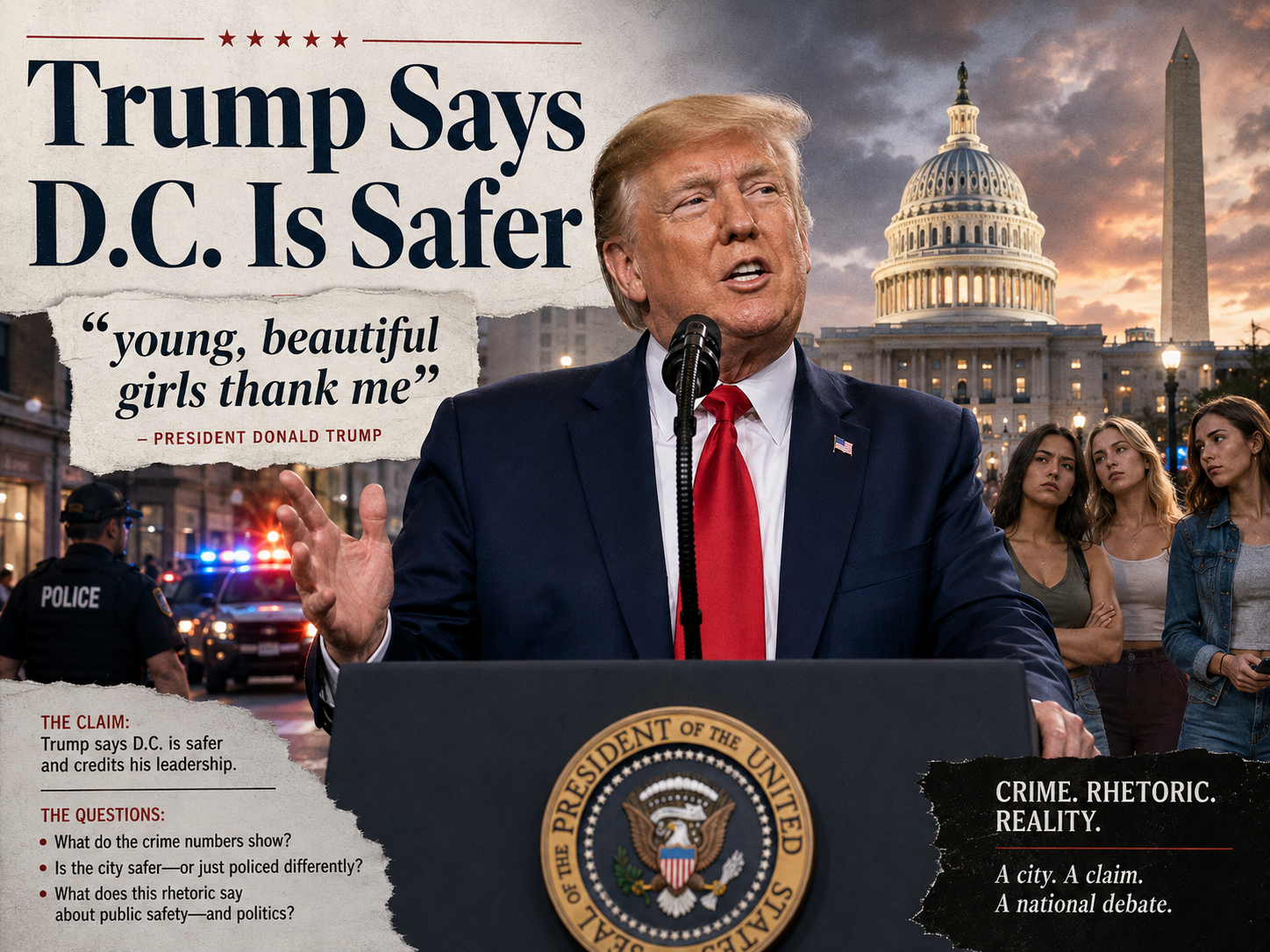
Trump Says Women Thank Him for Making D.C. Safer, Drawing Scrutiny Over Phrasing
By The Daily Ledger2 min read39 views
Donald Trump claimed that young women are thanking him for making Washington, D.C. safer, a comment that has drawn attention for both its phrasing and its…
Trump Claims Credit for Washington Safety in Remarks About 'Young, Beautiful Girls'
President Donald Trump claimed this week that women in Washington, D.C. have been personally thanking him for making the nation's capital safer, drawing immediate attention for both the substance of the assertion and the phrasing he chose to deliver it.
Trump made the remarks [VERIFY: confirm exact venue — speech, press availability, social media, or interview] during [VERIFY: date and location of statement], framing improvements in public safety in the city as a direct result of his administration's policies. "Young, beautiful girls come up to me and say, 'Thank you for making Washington safe,'" Trump said, according to [VERIFY: confirm source and exact quote].
The comment reflects a theme Trump has returned to repeatedly: that his emphasis on law enforcement and federal authority over the district has produced measurable results. Washington, D.C. occupies a distinctive position in American governance — unlike states, the capital falls under substantial federal jurisdiction, giving the executive branch direct authority over agencies such as the D.C. National Guard and influence over federal prosecution priorities.
Crime in Washington rose sharply in the early 2020s, with homicides, carjackings, and robberies drawing sustained public concern and criticism of local leadership. [VERIFY: latest available crime statistics from the Metropolitan Police Department and whether recent trends show a meaningful decline.] Whether those trends have shifted in a direction that would support Trump's claims — and how much credit, if any, belongs to federal rather than local policy — remains a matter that analysts and local officials are likely to contest.
Critics were quick to focus not only on the factual basis of the safety claims but on Trump's choice of words. Advocacy groups and political opponents argued that describing women as "young" and "beautiful" in the context of a policy discussion reduced them to their physical appearance rather than their standing as citizens. [VERIFY: specific organizations or figures who responded and what they said.]
The White House [VERIFY: whether the administration issued any clarification or defense of the remarks] did not immediately elaborate on which specific federal initiatives Trump was crediting for the alleged improvement.
The episode is consistent with a broader pattern in Trump's public rhetoric, in which vivid personal anecdotes — often featuring unnamed individuals expressing gratitude — are used to illustrate policy arguments. Supporters say the style makes complex issues accessible; detractors argue it substitutes sentiment for evidence.
D.C. Mayor [VERIFY: current mayor and whether they responded] and members of the D.C. Council, which has frequently clashed with federal officials over control of the city's budget and public safety decisions, had not issued a formal public response at the time of publication. [VERIFY and update.]
Comments (0)
No comments yet. Be the first to share your thoughts.
Leave a comment
Comments are reviewed before they appear.