 World
World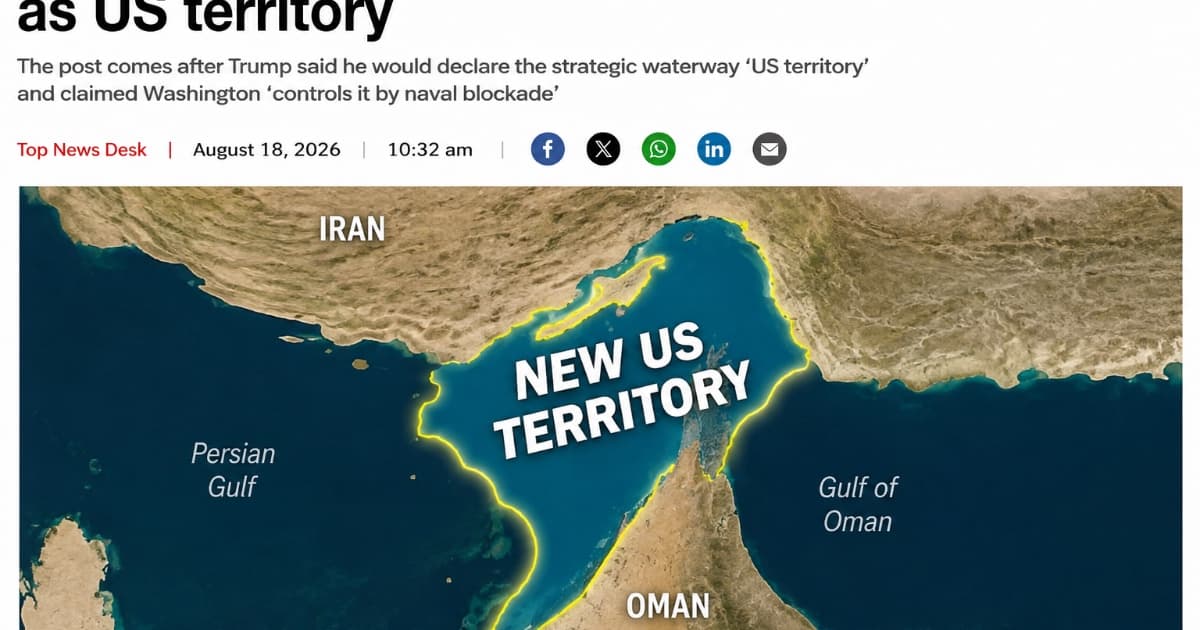
President Donald Trump has posted a provocative map depicting the Strait of Hormuz as “NEW US Territory,” escalating his push to claim American control over one of the world’s most strategically important waterways as the confrontation with Iran continues.
Trump Posts Map Showing Strait of Hormuz as ‘New US Territory’ as Iran Tensions Escalate
President Donald Trump has dramatically escalated his rhetoric over the Strait of Hormuz, posting a map that depicts the strategically vital waterway as “NEW US Territory” amid the continuing confrontation between Washington and Tehran.
Trump shared the image on his Truth Social account on Tuesday, August 18.
The map highlights the Strait of Hormuz — the narrow maritime passage connecting the Persian Gulf with the Gulf of Oman — and places the words “NEW US Territory” over the highlighted area.
Trump provided little explanation alongside the image.
But the post follows a series of extraordinary statements from the president suggesting that the United States should claim the strait.
The development is likely to intensify an already volatile dispute involving the United States, Iran and Oman over control, security and commercial access to one of the most important shipping routes in the world.
Trump Posts the Map
Trump's latest move was visual and unmistakable.
The president published a map of the region surrounding the Strait of Hormuz with a section prominently marked as “NEW US Territory.”
The post does not itself change the legal status of the waterway.
But politically, it reinforces Trump's earlier statements that the United States should claim the strait.
Trump first publicly floated the idea several days earlier.
He argued that American military power and the U.S. blockade had effectively placed the strategically important waterway under Washington's control.
The map now appears to reinforce that argument.
Trump Says the U.S. Controls the Strait
Trump has defended his position by pointing to American military control in the region.
When questioned about his previous remarks, Trump said the United States controls the waterway through its blockade.
His argument appears to be that because American forces can determine or influence maritime access, Washington has effectively established control over the strait.
That is very different, however, from internationally recognized sovereignty.
Military control over a location does not automatically transform it into sovereign U.S. territory.
The distinction will be central to the international debate surrounding Trump's latest move.
Why the Strait of Hormuz Matters
The Strait of Hormuz is one of the most strategically important waterways on Earth.
It connects the Persian Gulf with the Gulf of Oman and ultimately the Arabian Sea.
Iran sits along the northern side of the strait.
Oman controls territory along its southern side.
For decades, the waterway has served as a critical corridor for international energy transportation.
Oil and liquefied natural gas produced by Gulf states move through Hormuz on their way to customers around the world.
Historically, roughly one-fifth of global petroleum consumption has passed through the strait.
That means even relatively small disruptions can influence global energy markets.
A prolonged closure could have much more serious consequences.
The Iran War Has Transformed Hormuz
The strategic importance of Hormuz has become even greater during the current U.S.-Iran confrontation.
Iran has severely restricted maritime traffic through the waterway.
Tehran views its position around Hormuz as one of its strongest sources of geopolitical leverage.
Washington, meanwhile, wants international commercial shipping restored.
The United States has deployed substantial military resources to the region and established a blockade as part of its broader pressure campaign against Iran.
That has turned the strait into both a military and economic battlefield.
Trump's territorial claim adds another layer to the dispute.
Iran Rejects Trump's Position
Iran has strongly rejected Trump's suggestion that the United States could claim the waterway.
Iranian officials have dismissed the idea and emphasized Tehran's own rights and strategic position in the region.
From Iran's perspective, American claims over the strait represent an unacceptable expansion of U.S. power immediately off the Iranian coast.
The dispute therefore extends beyond shipping.
It now involves questions of sovereignty, military power and the future security structure of the Persian Gulf.
Oman Is Also Central to the Story
Iran is not the only country directly affected by Trump's statements.
Oman sits on the opposite side of the Strait of Hormuz.
That means any American attempt to claim the waterway would inevitably involve Omani interests.
Oman has traditionally maintained close relations with Washington while simultaneously keeping diplomatic channels open with Tehran.
That unusual position has allowed Muscat to serve as an intermediary during previous U.S.-Iran crises.
But relations have become more complicated.
Trump recently threatened military action against Oman if it obstructed American objectives surrounding Hormuz.
At the same time, Oman has been negotiating with Iran over arrangements designed to facilitate maritime traffic through the strait.
Does Trump's Map Make Hormuz American Territory?
No.
Posting a map on social media does not legally transfer sovereignty over international waters or territory belonging to another country.
Territorial sovereignty is governed by international law, treaties, recognized maritime boundaries and agreements between states.
A unilateral social-media declaration does not automatically override those frameworks.
Trump's map should therefore be understood as a political assertion rather than proof that the United States has legally acquired the Strait of Hormuz.
The distinction is especially important for news coverage.
The accurate statement is that Trump has posted a map depicting Hormuz as U.S. territory.
It would be inaccurate to report that the United States has legally annexed the waterway simply because the president posted the image.
Could the United States Actually Claim It?
Any serious attempt by Washington to establish sovereignty over the strait would raise enormous legal and diplomatic questions.
The waterway borders Iran and Oman.
International maritime law also governs navigation through strategically important straits used for global shipping.
A unilateral American claim would almost certainly be rejected by Iran.
Oman would also have major interests at stake.
Other governments dependent on Hormuz for energy transportation could oppose any action that created uncertainty about freedom of navigation.
The result could be a significant international confrontation extending well beyond Washington and Tehran.
Global Oil Markets Are Watching
Energy markets have already been affected by the U.S.-Iran conflict.
The reduction in shipping through Hormuz has created uncertainty over global oil supplies.
Any suggestion that the legal or military status of the waterway could fundamentally change adds another source of risk.
Energy traders closely monitor developments around Hormuz because interruptions can affect millions of barrels of oil moving through the region.
Higher perceived risk can contribute to increased oil prices, shipping costs and insurance premiums.
Those costs can eventually affect consumers through higher fuel and transportation prices.
Trump's Strategy Appears to Be About Control
Trump's statements suggest that he views physical control over Hormuz as a central element of his strategy toward Iran.
Washington wants to prevent Tehran from using the strait as leverage over the international economy.
Iran, meanwhile, understands that its geographic position gives it enormous strategic influence.
That creates a fundamental conflict.
If Tehran can restrict shipping, it can impose economic costs far beyond the Middle East.
If Washington can guarantee maritime access, it reduces one of Iran's strongest sources of leverage.
Trump's proposal to treat the strait as American territory appears to take that strategic argument much further.
The Map Raises Questions About U.S. Objectives
Until now, Washington's publicly stated objectives have focused heavily on preventing Iran from obtaining nuclear weapons, protecting American forces and restoring international shipping.
Trump's territorial rhetoric creates a new question.
Is the administration simply using provocative language to pressure Tehran?
Or does Trump genuinely intend to pursue some form of permanent American control over the waterway?
The map alone does not answer that question.
Trump has not publicly provided a detailed legal or diplomatic plan explaining how the United States could transform the strait into American territory.
That uncertainty is likely to fuel international concern.
A New Pressure Tactic?
The map could also be interpreted as another negotiating tactic.
Trump frequently uses maximalist public demands during negotiations.
By proposing something Tehran would find completely unacceptable, Washington could attempt to increase pressure before later negotiations.
But that strategy carries risks.
Iran could interpret the claim as evidence that Washington seeks territorial expansion rather than simply changes to Iranian behavior.
That perception could make compromise more difficult.
It could also strengthen Iranian hardliners who argue that the United States cannot be trusted.
International Law Will Be Closely Watched
Any effort to alter the territorial status of Hormuz would face intense international scrutiny.
The Strait of Hormuz is not simply a bilateral issue between Washington and Tehran.
Countries across Asia and Europe rely on energy shipped through the region.
Gulf states also have major economic and security interests there.
International maritime law establishes rules governing passage through straits used for global navigation.
Any attempt to fundamentally alter those arrangements could therefore affect the broader international system.
The Risk of Military Miscalculation
The greatest immediate danger remains military escalation.
American and Iranian forces are operating in and around an extremely narrow strategic waterway.
Commercial vessels are also attempting to navigate the region.
Political rhetoric is becoming increasingly aggressive.
Under those circumstances, a relatively small confrontation could rapidly escalate.
An incident involving a naval vessel, tanker or aircraft could trigger retaliation.
Trump's territorial rhetoric could further complicate military decision-making if either side begins treating disputed waters differently.
What Happens Next?
Several questions now become critical.
Will Trump provide a formal explanation of what he means by “NEW US Territory”?
Will the administration announce an actual policy attempting to establish permanent American control?
How will Iran respond?
What position will Oman take?
And how will other major governments react if Washington begins treating the president's social-media map as more than political rhetoric?
Until those questions are answered, the legal status of the Strait of Hormuz has not changed simply because Trump posted a map.
Bottom Line
President Donald Trump has posted one of his most provocative images yet regarding the U.S.-Iran conflict.
The map shared on Truth Social depicts the Strait of Hormuz as “NEW US Territory.”
It follows Trump's earlier statements that he wants to declare the strategically vital waterway part of the United States and his argument that Washington already effectively controls it through a naval blockade.
The implications are potentially enormous.
Hormuz sits between Iran and Oman and serves as one of the world's most important energy-shipping routes.
But Trump's social-media post does not itself legally transfer sovereignty over the strait to the United States.
For now, the map represents an extraordinary political and territorial assertion — not an internationally recognized change in borders.
Whether Trump intends to turn that assertion into formal U.S. policy could become one of the next major flashpoints in the confrontation with Iran.
Comments (0)
No comments yet. Be the first to share your thoughts.
Leave a comment
Comments are reviewed before they appear.