 World
World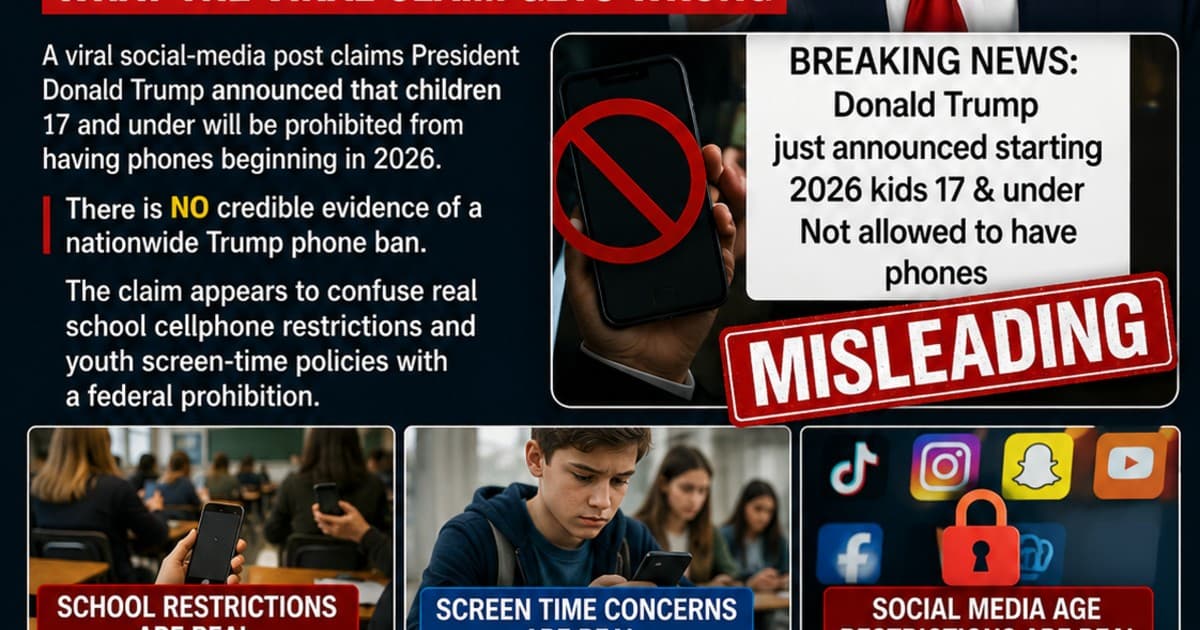
World
Trump Banning Phones for Kids 17 and Under in 2026? What the Viral Claim Gets Wrong
By The Daily Ledger6 min read157 views
A viral social-media post claims President Donald Trump announced that children 17 and under will be prohibited from having phones beginning in 2026. But there is no credible evidence of a nationwide Trump phone ban. The claim appears to confuse real school cellphone restrictions and youth screen-time policies with a federal prohibition.
Trump Banning Phones for Kids 17 and Under in 2026? What the Viral Claim Gets Wrong
A viral social-media post claims President Donald Trump has announced that beginning in 2026, children and teenagers age 17 and under will no longer be allowed to have phones.
The claim has been presented as “BREAKING NEWS,” potentially giving viewers the impression that the Trump administration has introduced a sweeping nationwide policy.
However, there is currently no credible evidence supporting the claim that Trump announced a federal ban preventing everyone 17 and under from owning or having a phone.
The viral post appears to combine several genuine debates surrounding children's smartphones, social media and screen time into a much broader and unsupported claim.
What Does the Viral Post Claim?
The image circulating online states that Trump announced that starting in 2026, children 17 and younger will not be allowed to have phones.
If true, such a policy would represent an extraordinary change affecting millions of American families.
A nationwide prohibition on minors possessing smartphones would also raise major questions involving enforcement, parental authority, education, emergency communication and federal versus state powers.
But no credible evidence has emerged showing that Trump announced such a policy.
No Verified Nationwide Trump Phone Ban
The most important distinction is between a nationwide ban on minors having phones and restrictions on when students can use phones at school.
They are not the same policy.
There has been significant political momentum across the United States toward limiting smartphones in classrooms.
States, school districts and individual schools have introduced rules requiring students to keep phones away during lessons — and in some cases throughout the entire school day.
But these rules generally do not prevent children or teenagers from owning smartphones.
A student may still have a phone outside school even if its use is prohibited during class.
Why the Claim May Sound Believable
The viral post comes at a time when concerns about young people's relationships with smartphones and social media are receiving significant political attention.
Parents, educators, researchers and politicians have debated whether constant access to smartphones affects children's concentration, sleep, education and social interaction.
That debate has resulted in real policy changes.
Phone-free classrooms and school days have become increasingly common.
Some governments have also considered age-verification requirements and restrictions on children's access to certain social-media platforms.
Those developments can make an exaggerated claim about a nationwide phone ban sound more plausible than it actually is.
Trump Administration Has Addressed Screen Time
The Trump administration has also addressed children's use of screens.
Federal health officials have raised concerns about excessive recreational screen time among children and teenagers.
Those discussions focus on how much time young people spend using screens and how digital habits may affect sleep, physical activity and face-to-face interaction.
But recommendations or guidance concerning screen time are very different from a federal law prohibiting teenagers from possessing smartphones.
The existence of one should not be treated as evidence of the other.
School Cellphone Restrictions Are Real
The genuine policy story developing across America concerns schools.
Many educators argue that smartphones can distract students during lessons.
Notifications, messaging, games, videos and social-media platforms can compete directly with classroom instruction.
As a result, schools have experimented with policies ranging from requiring phones to remain inside backpacks to using locked storage pouches throughout the school day.
Some states have gone further by establishing statewide requirements or encouraging school districts to develop phone-free policies.
These measures can significantly affect students and families.
But a school cellphone restriction does not mean the government has prohibited a teenager from owning a phone.
Social-Media Restrictions Are Expanding Internationally
Another development that may contribute to confusion is the international push to restrict children's access to social media.
Some governments have introduced or considered age-based restrictions for younger users.
These policies focus primarily on access to social-media services.
They do not necessarily prohibit a child from owning a smartphone.
A teenager could possess a phone while being restricted from creating accounts on particular platforms.
That distinction matters.
What Would a Nationwide Phone Ban Mean?
If the federal government genuinely attempted to prohibit every American age 17 and younger from possessing a smartphone, it would represent an enormous national policy change.
Such a proposal would require answers to numerous practical and legal questions.
Would parents be prohibited from purchasing phones for their children?
Would basic phones without social-media applications be permitted?
Could teenagers carry phones for emergencies?
How would schools and working teenagers be affected?
Who would enforce the restrictions?
Would parents face penalties?
There are no verified answers to those questions because there is no confirmed nationwide policy matching the viral claim.
Be Careful With “Breaking News” Graphics
The episode also illustrates an important problem with consuming news through social media.
A professional-looking graphic does not prove that the information displayed on it is accurate.
Anyone can place words such as “BREAKING NEWS” over a photograph or video.
For major presidential announcements, readers should expect confirmation through official government statements, presidential remarks, legislation or reporting from multiple established news organizations.
If an extraordinary claim exists only in social-media videos and reposted graphics, that should immediately raise questions.
Could Phone Restrictions Expand in the Future?
Government policy can change.
Trump or members of his administration could support additional restrictions involving children's smartphone or social-media use.
Congress could debate legislation.
States could adopt stronger rules.
Schools could continue expanding phone-free policies.
But possible future action should not be confused with an announcement that has already occurred.
There is currently no credible basis for saying Trump announced that everyone 17 and under will be banned from having phones beginning in 2026.
What Parents Should Know
Parents who encounter the viral claim should check policies affecting their own state, school district and school.
Those rules can differ substantially.
A student's school may prohibit phones during lessons, require devices to remain stored throughout the school day or allow limited use during designated periods.
These school-level and state-level restrictions are different from a nationwide prohibition on phone ownership.
Bottom Line
The viral claim that President Donald Trump announced a 2026 nationwide ban preventing children and teenagers age 17 and under from having phones is not supported by credible evidence.
There is a genuine movement toward restricting cellphone use in schools.
There is also growing political concern about children's screen time and social-media use in the United States and internationally.
But those developments are not equivalent to a federal prohibition on minors owning phones.
Until an official government announcement or other authoritative evidence establishes otherwise, posts claiming Trump has banned phones for everyone 17 and under should be treated as unverified and misleading.
When an extraordinary political announcement appears on social media, the words “BREAKING NEWS” are not evidence by themselves. Checking the original source before sharing can prevent misinformation from spreading.

Comments (0)
No comments yet. Be the first to share your thoughts.
Leave a comment
Comments are reviewed before they appear.