 World
World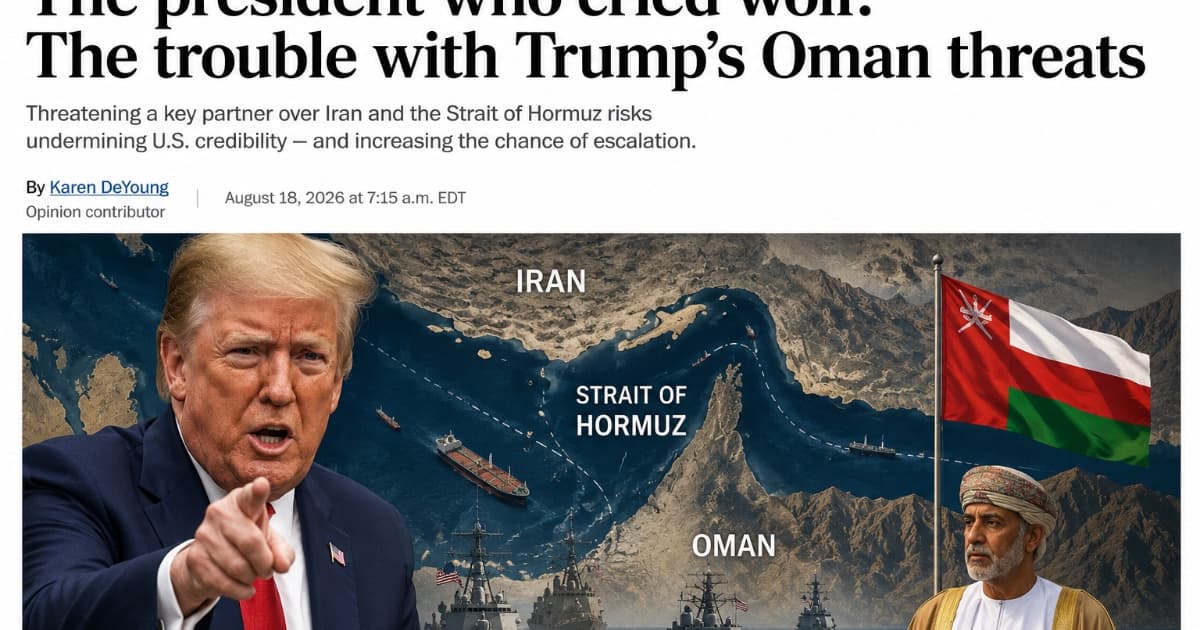
World
The President Who Cried Wolf: The Trouble With Trump’s Oman Threats | Opinion
By The Daily Ledger10 min read39 views
President Donald Trump’s renewed threat to bomb Oman is the latest example of his reliance on extreme warnings as a negotiating tool. But when threats are repeatedly issued, deadlines move and promised breakthroughs fail to materialize, Washington risks weakening the credibility that makes presidential warnings effective in the first place.
The President Who Cried Wolf: The Trouble With Trump’s Oman Threats
OPINION
President Donald Trump has threatened Oman again.
This time, the warning is extraordinarily explicit: if Oman gets in the way of Washington's objectives surrounding Iran and the Strait of Hormuz, Trump says the United States could bomb it.
The immediate reaction is understandably focused on the severity of the language.
But there is another problem worth considering.
What happens when the president of the United States makes so many dramatic threats that allies and adversaries begin wondering which ones he actually intends to carry out?
That is the credibility problem now confronting Trump's approach to the Iran war.
Trump wants Tehran to believe his warnings.
He wants Oman to take his demands seriously.
He wants American allies to believe Washington will defend its interests.
And he wants markets to believe the United States can ultimately restore stability to one of the world's most important energy corridors.
But credibility is a limited resource.
Every threat that is issued and then abandoned can make the next threat less powerful.
Trump risks becoming, in diplomatic terms, the president who cried wolf.
Trump's Extraordinary Warning to Oman
Trump's latest remarks came as attempts to resolve the U.S.-Iran conflict reached another critical moment.
A 60-day period established under an earlier memorandum expired without producing the comprehensive agreement Trump wanted.
Trump said Iran was unwilling to make the kind of deal he considered necessary.
He also demanded that Tehran surrender.
Then he turned his attention toward Oman.
Oman has been negotiating with Iran over arrangements involving commercial shipping through the Strait of Hormuz.
Trump warned that if Oman obstructed American objectives, it could face military action.
This was not the first time he had threatened the Gulf country.
That matters because Oman is not simply another American adversary.
It has traditionally been an important regional partner and, crucially, a diplomatic intermediary.
Why Oman Matters
Oman occupies an unusual position in Middle Eastern diplomacy.
It maintains relations with Washington.
It also maintains communication with Tehran.
That ability to speak to competing sides has made Oman useful during some of the region's most difficult diplomatic crises.
When direct communication between the United States and Iran becomes politically impossible, intermediaries become enormously valuable.
Threatening one of those intermediaries therefore creates an obvious contradiction.
Washington needs leverage against Iran.
But Washington may also need countries capable of communicating with Iran.
Oman can potentially provide that channel.
Bombing or seriously alienating Oman would destroy much of that diplomatic value.
Even threatening to do so can make cooperation more difficult.
The Strait of Hormuz Is at the Center
The immediate dispute revolves around the Strait of Hormuz.
Few pieces of geography matter more to the global economy.
The narrow waterway connects the Persian Gulf to the Gulf of Oman and the Arabian Sea.
Enormous quantities of oil and liquefied natural gas normally move through it.
Iran's ability to disrupt that traffic gives Tehran considerable strategic leverage.
Washington wants the strait reopened and commercial navigation restored.
Oman and Iran have been working on their own arrangements concerning maritime traffic.
The Trump administration is unhappy with important elements of those discussions.
That disagreement is serious.
But disagreement with an ally is different from treating that ally as an enemy.
Trump's Theory of the Threat
There is a recognizable strategy behind Trump's language.
Trump believes unpredictability creates leverage.
If an adversary thinks he might actually take extreme action, that adversary may compromise before finding out.
There is historical logic behind that approach.
Richard Nixon famously embraced a version of the "madman theory" during the Cold War — encouraging adversaries to believe an American president might behave unpredictably enough that challenging him was too dangerous.
Trump's political career has frequently relied on a similar principle.
Threaten enormous tariffs.
Threaten military action.
Set deadlines.
Demand maximal concessions.
Then negotiate.
Sometimes this works.
The problem emerges when the threats become too frequent.
Deterrence Depends on Credibility
A military threat does not derive its power simply from how frightening the words sound.
Its power comes from the target believing the threat might actually be carried out.
Imagine two presidents.
One rarely threatens military action but consistently follows through when he establishes a clear red line.
The other threatens military action repeatedly, changes deadlines and frequently announces that an agreement is close before negotiations collapse.
Which warning will an adversary take more seriously?
Probably the first.
That is the danger Trump faces.
The more often extraordinary threats become part of ordinary presidential rhetoric, the less extraordinary they become.
Eventually, opponents may begin waiting to see whether Trump actually acts.
At that point, the threat has lost much of its deterrent value.
The Iran War Has Produced Repeated Deadlines
Trump has repeatedly suggested that breakthroughs were approaching during the Iran conflict.
Deadlines have been established.
Negotiations have appeared close to success.
New demands have emerged.
Military threats have returned.
Then another negotiating window begins.
That cycle creates uncertainty.
Some uncertainty can be strategically useful.
Too much becomes strategic noise.
Iranian officials must now determine whether every Trump statement represents an actual change in American policy or simply another negotiating position.
American allies face the same problem.
The Wolf Problem
This is where the old story of the boy who cried wolf becomes relevant.
The lesson is not that warnings are inherently bad.
The lesson is that warnings lose value when people stop believing them.
Presidential threats operate according to the same principle.
If Trump threatens Oman today, Iran tomorrow and another government next week, every capital involved must decide whether these are genuine red lines or opening positions in negotiations.
Once leaders conclude that the answer is usually the latter, threatening them becomes less effective.
That creates a dangerous incentive.
To restore credibility, Trump may eventually feel compelled to act simply to demonstrate that his warnings cannot always be ignored.
That is how rhetorical escalation can become military escalation.
Oman Is an Especially Strange Target
There is another reason the threat deserves scrutiny.
Oman is precisely the type of country Washington should generally want available during a regional crisis.
It is geographically important.
It controls territory on the southern side of the Strait of Hormuz.
It maintains diplomatic relations across regional divides.
And it has experience facilitating sensitive negotiations.
A more conventional American strategy would attempt to use those relationships.
Trump instead risks turning the intermediary into another participant in the confrontation.
That could leave fewer diplomatic exits if the conflict deteriorates.
Iran Is Watching
Tehran will study Trump's treatment of Oman closely.
Iranian leaders are not simply evaluating American military capabilities.
They are evaluating American political behavior.
If they believe Trump desperately wants an agreement, they may conclude that waiting increases their leverage.
If they believe his military threats are credible, they may compromise.
If they believe neither side can predict what Washington will do, they may prepare for escalation.
Iran has already signaled that it could adopt a more offensive posture around Hormuz if diplomacy fails.
That makes miscalculation increasingly dangerous.
America's Allies Are Watching Too
Credibility is not only about intimidating adversaries.
It is also about reassuring friends.
American allies need to understand what Washington expects from them and what Washington will do in return.
If cooperating with the United States can suddenly be followed by threats of bombing when disagreements emerge, smaller partners may begin hedging their relationships.
They may seek greater protection from other powers.
They may avoid mediating American disputes.
Or they may simply become less willing to take diplomatic risks on Washington's behalf.
None of those outcomes strengthens American influence.
Oil Markets Cannot Ignore This
There is also an economic cost to diplomatic unpredictability.
Hormuz is one of the world's most important energy chokepoints.
Markets therefore react quickly to signs that the conflict could worsen.
Oil prices have risen as hopes for a U.S.-Iran settlement have faded.
Every additional threat increases uncertainty surrounding shipping, insurance, energy supplies and regional security.
That uncertainty eventually reaches consumers.
Higher transportation costs can raise prices throughout the economy.
Higher energy prices can complicate inflation.
And prolonged instability can weaken business confidence.
Presidential rhetoric around Hormuz therefore has consequences far beyond foreign policy.
Trump's Defenders Have a Counterargument
There is a legitimate counterargument.
Trump's supporters would say conventional diplomacy failed to prevent Iran from becoming a major regional security threat.
From this perspective, polite diplomatic language produced decades of stalemate.
Trump's willingness to threaten overwhelming force creates pressure that conventional negotiations cannot.
His defenders can also point out that unpredictability prevents adversaries from confidently calculating America's response.
If Iran genuinely believes Trump might escalate dramatically, that fear could push Tehran toward concessions.
This argument should not simply be dismissed.
Coercive diplomacy can work.
Military threats can produce agreements without actual military action.
But they work best when the threat is credible.
That returns us to the original problem.
Threatening Everyone Is Not the Same as Deterring Everyone
There is a fundamental difference between demonstrating strength and constantly announcing threats.
Strength can be quiet.
The presence of American naval forces near Hormuz already communicates enormous military capability.
Iran knows what those forces can do.
Oman knows.
Every government in the Gulf knows.
Washington therefore does not necessarily need increasingly extreme rhetoric to demonstrate that capability.
Sometimes the most effective threat is the one that does not need to be repeated.
The Risk of Accident
The current situation is particularly dangerous because American and Iranian forces are operating around a narrow maritime corridor.
Commercial ships are still moving through parts of the region.
Military assets are nearby.
Iran is threatening escalation.
Washington is maintaining pressure.
And political rhetoric is becoming increasingly confrontational.
In this environment, one mistaken identification, one damaged ship or one unexpected military encounter could create a crisis neither side intended.
Presidents should therefore be especially careful about introducing additional uncertainty.
What Trump Actually Needs
Trump does not need Oman to fear that America might suddenly bomb it.
He needs Oman to help produce an arrangement Washington can live with.
He does not need Iran to dismiss every American threat.
He needs Iran to believe there are consequences for refusing a workable agreement.
And he does not need the world wondering whether every new presidential statement represents American policy.
He needs American commitments to mean something.
That requires discipline.
The Difference Between Unpredictability and Unreliability
Trump has long viewed unpredictability as an advantage.
Sometimes it is.
But unpredictability and unreliability are not identical.
An unpredictable president keeps adversaries uncertain about how he will enforce clearly understood interests.
An unreliable president leaves everyone uncertain about whether his own statements matter.
The first can create leverage.
The second destroys it.
That distinction may determine whether Trump's approach to Iran ultimately produces an agreement or simply another cycle of threats.
Bottom Line
Trump's renewed threat against Oman may produce immediate headlines.
It may frighten policymakers.
It may even increase short-term negotiating pressure.
But American foreign policy operates over a much longer horizon.
Every presidential warning becomes part of Washington's credibility.
If Trump repeatedly threatens extraordinary action without following through, adversaries may eventually learn to wait him out.
If he follows through simply to prove his threats are real, the United States could find itself expanding a war it is supposedly trying to end.
Neither outcome is particularly attractive.
Trump's greatest challenge may therefore be less about finding a more frightening threat and more about making his existing words credible.
A superpower does not need to shout constantly to demonstrate its strength.
And a president should be careful how often he cries wolf — because one day, he may desperately need the world to believe him.
Comments (0)
No comments yet. Be the first to share your thoughts.
Leave a comment
Comments are reviewed before they appear.