 World
World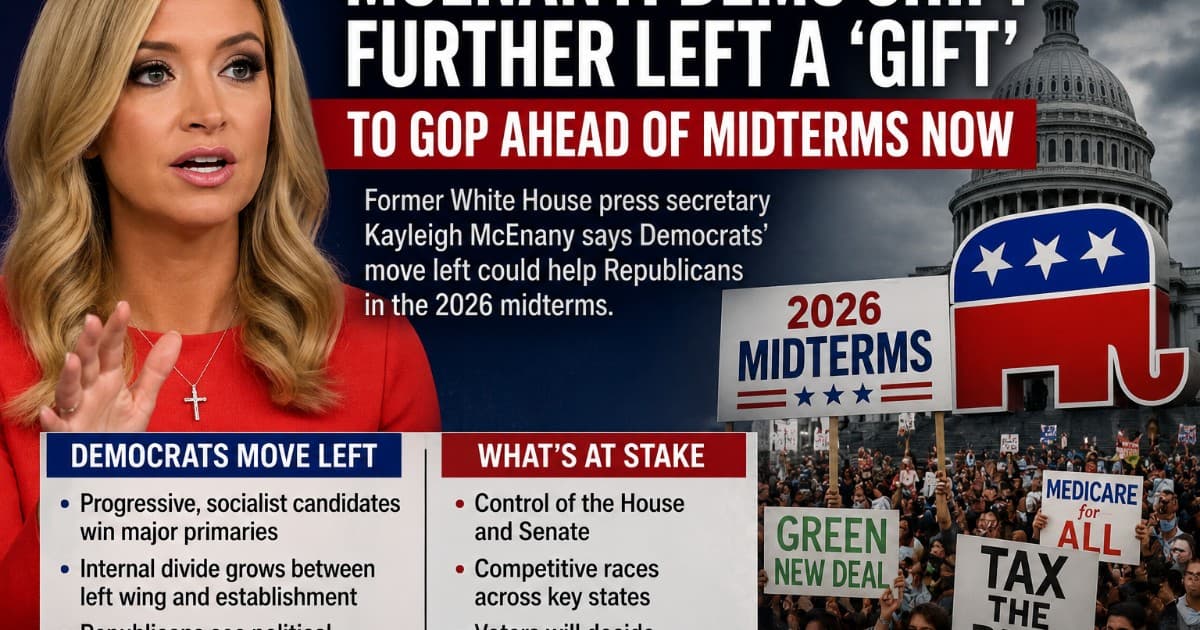
World
McEnany Says Democrats’ Shift Further Left Is a ‘Gift’ to Republicans Ahead of 2026 Midterms
By The Daily Ledger10 min read58 views
Former White House press secretary Kayleigh McEnany says the Democratic Party’s growing progressive and democratic-socialist wing could become a political “gift” to Republicans in the 2026 midterms. Her argument comes after left-wing candidates scored notable primary victories, intensifying a Democratic debate over whether progressive momentum will energize voters or make the party more vulnerable in competitive districts.
McEnany Says Democrats’ Shift Further Left Is a ‘Gift’ to Republicans Ahead of 2026 Midterms
Former White House press secretary Kayleigh McEnany says the Democratic Party's increasingly powerful progressive wing may be giving President Donald Trump and Republicans an unexpected advantage ahead of the 2026 midterm elections.
McEnany, now a Fox News host, argued that the rise of democratic-socialist and strongly progressive candidates could make it easier for Republicans to portray Democrats as moving outside the political mainstream.
Her comments come amid an increasingly intense battle over the future direction of the Democratic Party.
Progressive candidates have scored several significant primary victories in heavily Democratic areas, challenging longtime incumbents and establishment-backed candidates.
Those victories have energized the party's left wing.
Republicans, however, see an opportunity.
Their argument is simple: the further Democratic candidates move left during primary elections, the easier it may become for Republicans to attack the party's agenda during the November general election.
But with control of Congress at stake, whether that strategy actually works remains far from certain.
McEnany Calls the Democratic Shift a Republican “Gift”
During a discussion of the upcoming midterm elections, McEnany argued that Republicans could benefit from Democrats embracing candidates associated with democratic socialism and the party's progressive wing.
She described the development as a political “gift” to Republicans.
The argument reflects a strategy Republicans have used repeatedly in recent elections.
Rather than campaigning exclusively against individual Democratic candidates, Republicans attempt to connect vulnerable Democrats with the most progressive figures and proposals inside the party.
That can include debates over taxation, government spending, health care, immigration, policing and the role of government in the economy.
Republicans hope that voters in politically competitive districts will view those positions as too far left.
Progressive Victories Shake Democratic Politics
McEnany's comments did not emerge in a vacuum.
Progressive and democratic-socialist candidates have recently scored notable victories in Democratic primary elections.
Several candidates supported by New York City Mayor Zohran Mamdani and other progressive organizations have defeated more moderate or establishment Democrats.
In Colorado, progressive challenger Melat Kiros defeated longtime Democratic Rep. Diana DeGette in a major primary upset.
Other left-wing candidates have also demonstrated that progressive activists possess substantial organizational strength.
Those victories have encouraged progressive Democrats who believe the party needs fundamental change.
They argue that Democrats cannot defeat Trump-era Republican politics simply by offering voters a slightly different version of the political establishment.
Republicans See an Opening
Republicans view the same developments very differently.
GOP strategists hope Democrats will nominate candidates whose political positions can be portrayed as too liberal for competitive districts.
The strategy could become particularly important in suburban congressional districts.
Voters in those areas may dislike Trump or disagree with Republican policies while simultaneously remaining skeptical of democratic socialism.
Republicans therefore want to force voters to choose between two competing concerns.
Instead of allowing the election to become exclusively a referendum on Trump, they want voters focused on what a Democratic congressional majority might actually do.
That is where McEnany believes the Democratic Party's leftward movement could become valuable to Republicans.
The Democratic Socialist Movement Is Growing
The Democratic Socialists of America and allied progressive organizations have become increasingly influential in Democratic politics.
Their candidates generally support a much larger role for government in areas including health care, housing, labor rights and child care.
They frequently advocate higher taxes on wealthy Americans and corporations.
Many also support stronger unions and greater government involvement in controlling housing and health-care costs.
These positions can be extremely popular among progressive voters.
They are particularly attractive to younger Democrats frustrated by housing costs, student debt, health-care expenses and economic inequality.
But Republicans believe those same proposals can become liabilities in general elections.
Democrats Face an Internal Argument
The primary victories have intensified a debate that has existed inside the Democratic Party for years.
Progressives argue that establishment Democrats have failed to offer voters sufficiently ambitious solutions to economic problems.
They believe Democrats need a clearer populist economic agenda.
Moderates counter that winning Democratic primaries in overwhelmingly blue districts is very different from winning general elections in politically divided states.
A democratic socialist can potentially win easily in parts of New York City.
The same political brand may perform very differently in a swing district in Pennsylvania, Michigan, Arizona or another battleground.
That distinction is at the center of the Democratic debate.
The Mamdani Effect
New York City Mayor Zohran Mamdani has become an especially important figure in this ideological struggle.
His political success demonstrated that democratic-socialist candidates can build powerful coalitions around affordability and economic populism.
Candidates he supported have subsequently won additional Democratic primaries.
That has encouraged progressives to argue that Mamdani's success represents something larger than New York politics.
They believe voters are responding to a clear economic message focused on housing, wages, health care and the cost of living.
Republicans are equally eager to nationalize Mamdani.
They want voters across the country to associate Democratic congressional candidates with his ideology.
McEnany's Argument Has Historical Logic
There is nothing unusual about one political party hoping its opponent nominates candidates considered easier to defeat.
Both Republicans and Democrats have attempted this strategy.
Democrats have sometimes preferred facing strongly pro-Trump Republican candidates rather than moderate Republicans.
Republicans have similarly welcomed progressive Democratic nominees they believe can be portrayed as outside the mainstream.
The strategy can work.
But it can also backfire.
Candidates considered too ideological sometimes generate unusually high enthusiasm among voters who otherwise might not participate.
That makes predicting the consequences of the Democratic Party's ideological shift difficult.
Republicans Have Their Own Midterm Problems
McEnany's argument also comes with an important complication.
Republicans are not entering the 2026 midterms from an overwhelmingly dominant position.
The president's party historically struggles during midterm elections.
Voters often use midterms to express dissatisfaction with the sitting administration.
Republicans must therefore defend their congressional majorities while Trump occupies the White House.
Several competitive races have recently moved toward Democrats.
Sabato's Crystal Ball has shifted three Senate contests in Democrats' direction, giving the party a clearer potential route to winning the Senate majority.
The forecaster still considers Republicans better positioned overall to retain Senate control.
But the movement demonstrates that a Republican victory is far from guaranteed.
Democrats Have a Path to the Senate
Democrats need a net gain of four Senate seats to regain control.
That remains difficult.
Republicans benefit from the existing Senate map and only need to win one of several major toss-up contests to make the Democratic path substantially harder.
Still, competitive races have developed across multiple states.
That means candidate quality will matter enormously.
A strong Democratic candidate could outperform the national political environment.
A weak candidate could turn a potentially competitive race into a Republican victory.
The same applies to Republicans.
The House Could Be Even More Volatile
The battle for the House of Representatives may be even more unpredictable.
The Republican majority is narrow.
That means a relatively small number of competitive districts could determine control of the chamber.
Redistricting has further complicated the battlefield.
Both parties are fighting over congressional maps while simultaneously recruiting candidates and raising money.
Democrats are expanding the number of Republican-held districts they hope to contest.
Republicans, meanwhile, are trying to nationalize the ideological divisions inside the Democratic Party.
The result could be one of the most intensely fought midterm elections in years.
Republicans Want the Election to Be About Socialism
McEnany's argument reveals an important part of the Republican messaging strategy.
Republicans would prefer the midterms not to become solely a referendum on Trump.
Instead, they want voters asking what Democrats would do if they controlled Congress.
The word “socialism” is likely to play a major role in that campaign.
Republicans will attempt to connect Democratic candidates with democratic-socialist politicians even when individual candidates do not share all of those positions.
That strategy is particularly aimed at swing voters.
Democrats Want the Election to Be About Trump
Democrats have the opposite incentive.
They want voters focused on Trump and Republican control of Washington.
Democratic candidates are likely to campaign heavily on the economy, health care, presidential power and controversial administration policies.
They will argue that electing Democratic majorities is necessary to provide a check on Trump.
That creates two competing narratives.
Republicans: A Democratic Congress would move America dramatically left.
Democrats: A Republican Congress would give Trump too little resistance.
Whichever argument resonates more strongly with swing voters could determine control of Congress.
Progressives Reject the Republican Narrative
Progressive Democrats reject the idea that moving left automatically hurts the party.
They argue that conventional Democratic politics has already failed many working-class voters.
From their perspective, Republicans have successfully attracted voters who are economically frustrated because Democrats have not offered sufficiently clear alternatives.
Progressives believe policies such as cheaper health care, stronger labor protections and more affordable housing can appeal far beyond traditional liberal constituencies.
Their argument is essentially that economic populism can win voters even when Republicans describe it as socialism.
The 2026 elections could provide an important test of that theory.
Candidate Geography Matters
The answer may ultimately depend on where candidates are running.
A strongly progressive candidate can be extremely successful in a deeply Democratic urban district.
A moderate Democrat may perform better in a suburban swing district.
A populist candidate could potentially succeed in a working-class area where a traditional establishment Democrat struggles.
There is no single ideological formula that works everywhere.
That makes national statements about Democrats moving “too far left” difficult to evaluate without examining individual races.
Trump Will Be Central to the Campaign
President Trump will inevitably dominate the midterm environment.
Republican candidates must decide how closely to associate themselves with him.
In heavily Republican areas, strong alignment with Trump can be essential.
In competitive districts, the calculation becomes more complicated.
Democrats will attempt to make Republican candidates answer for every controversial administration decision.
Trump, meanwhile, is expected to campaign aggressively for Republican candidates and portray Democratic victories as a threat to his agenda.
McEnany's message fits naturally into that strategy.
A Battle Over the Meaning of the Democratic Party
Beyond the immediate congressional races, the 2026 midterms could help determine the future identity of the Democratic Party.
If progressive candidates perform strongly, the party's left wing will argue that voters want a more ambitious economic agenda.
If those candidates struggle in competitive races, moderate Democrats will argue that ideological movement to the left cost the party winnable seats.
Those conclusions could directly influence the 2028 presidential primary.
Potential candidates will study which messages succeeded and which failed.
The ideological struggle taking place today could therefore shape Democratic politics for years.
Is It Really a “Gift” to Republicans?
That remains an open question.
McEnany is making a political argument, not reporting an established electoral fact.
There is evidence supporting parts of her case.
Progressive victories give Republicans recognizable ideological targets.
Some Democratic strategists themselves worry that democratic-socialist candidates could become liabilities outside heavily Democratic areas.
But there is evidence pointing in the opposite direction as well.
Progressive candidates have demonstrated significant grassroots enthusiasm.
Democrats have improved their position in several important races.
And Republicans face the historical challenge of defending congressional power while their party controls the White House.
The election itself will determine which interpretation proves correct.
Bottom Line
Kayleigh McEnany believes the Democratic Party's increasingly influential progressive and democratic-socialist wing is handing Republicans a political “gift” ahead of the 2026 midterm elections.
Her argument is straightforward.
The further Democrats move left, Republicans believe, the easier it becomes to portray Democratic candidates as outside the political mainstream.
Recent progressive primary victories give Republicans additional material for that campaign.
But Democrats see another possibility.
They believe an energized progressive movement focused on affordability and economic inequality could attract voters frustrated with both Washington and the Trump administration.
Meanwhile, independent election analysis shows a genuinely competitive environment rather than an inevitable Republican victory.
Democrats have recently gained ground in several Senate races, even though Republicans remain better positioned overall to retain that chamber.
That makes the coming election an unusually important political experiment.
Republicans are betting that America's voters will reject the Democratic Party's leftward movement.
Progressives are betting that voters are ready for it.
In November, Americans will begin providing the answer.
#Climate


Comments (0)
No comments yet. Be the first to share your thoughts.
Leave a comment
Comments are reviewed before they appear.