 World
World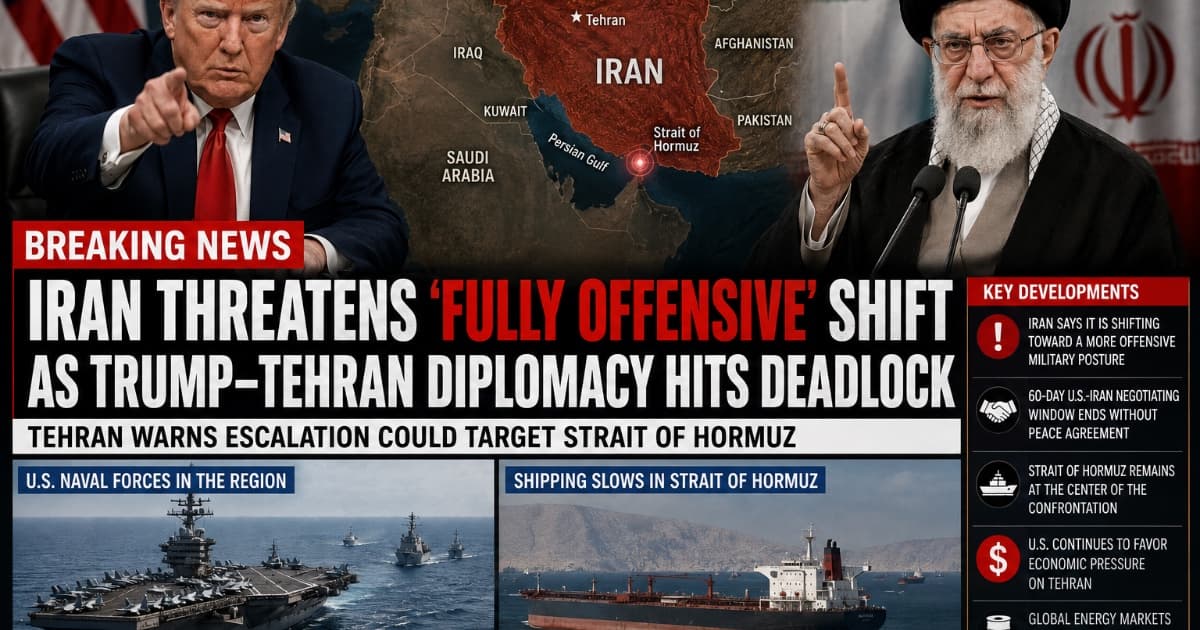
World
Iran Threatens ‘Fully Offensive’ Shift as Trump–Tehran Diplomacy Hits Deadlock
By The Daily Ledger7 min read22 views
Iran is threatening a more aggressive military posture as negotiations with the United States remain stalled, raising fears of renewed confrontation around the Strait of Hormuz and further disruption to global energy supplies.
Iran Threatens ‘Fully Offensive’ Shift as Trump–Tehran Diplomacy Hits Deadlock
Iran has threatened to adopt a significantly more aggressive military posture as diplomatic efforts with the United States remain stalled, raising new fears that the confrontation between Washington and Tehran could enter another dangerous phase.
The warning comes as the 60-day negotiating window established under an interim U.S.-Iran agreement reaches its end without producing a comprehensive peace settlement.
According to Reuters, an Iranian official said Tehran had decided to shift from a defensive approach toward what was described as a “fully offensive” strategy as confidence in diplomacy deteriorates.
Iran has also warned that it could take military action aimed at challenging the U.S. naval blockade if Washington does not fulfill what Tehran considers its obligations under the earlier agreement.
The developments place renewed attention on President Donald Trump’s next move as Washington attempts to pressure Tehran while avoiding another uncontrolled escalation across the Middle East.
Iran Signals a More Aggressive Strategy
Iran’s latest warning represents a significant escalation in rhetoric.
Tehran argues that Washington has failed to fully implement commitments contained in the interim agreement negotiated earlier this summer.
Iranian officials have indicated that the country is prepared to respond more aggressively if diplomatic efforts fail.
The warning does not mean that a specific new Iranian attack has been announced.
Instead, it signals that Tehran is attempting to increase pressure on Washington by demonstrating that continued diplomatic deadlock could carry military consequences.
That distinction is important as both sides attempt to strengthen their negotiating positions.
The 60-Day Negotiating Window Ends
The latest escalation comes at a critical diplomatic moment.
The United States and Iran entered a temporary framework earlier this summer intended to reduce hostilities and provide time for negotiations toward a broader agreement.
That negotiating period lasted 60 days.
AP reported on August 17 that the deadline has arrived without a comprehensive peace agreement.
Washington and Tehran remain divided over several fundamental issues, including Iran’s nuclear program, sanctions, the U.S. blockade and control of shipping through the Strait of Hormuz.
Both governments have accused the other of failing to honor previous commitments.
Those disagreements have prevented the temporary framework from developing into a lasting settlement.
Strait of Hormuz Becomes the Central Flashpoint
The Strait of Hormuz is now one of the most dangerous elements of the confrontation.
The narrow waterway links the Persian Gulf with international shipping routes and is crucial to global energy transportation.
Iran considers its geographic position around the strait an important source of strategic leverage.
The United States insists that international commercial vessels must have freedom of navigation through the waterway.
Those competing positions have created a fundamental disagreement that diplomacy has so far failed to resolve.
Iran has warned that it could take action in the strait if Washington continues its current approach.
The United States, meanwhile, maintains substantial naval capabilities in the region.
That creates the possibility that even a relatively limited incident could escalate quickly.
Iran Gives Washington a Warning
Reuters reports that Tehran is giving Washington a limited period to fulfill obligations Iran says were contained in the earlier agreement.
Iranian officials have suggested that mediators will communicate Tehran’s position to Washington and other governments in the region.
If no progress is achieved, Iran says it is prepared to increase pressure.
That could include efforts aimed at challenging the American blockade.
However, precisely what Tehran would do remains uncertain.
The warning therefore functions both as a military signal and as diplomatic leverage.
Iran wants Washington to believe that failing to compromise carries significant risks.
Trump Faces a Difficult Decision
The escalation presents President Trump with several difficult options.
Washington could attempt to restart negotiations.
It could increase economic sanctions.
It could maintain the existing blockade and military pressure.
Or it could respond militarily if Iran carries out actions threatening American forces or commercial shipping.
Each option carries risks.
Additional military escalation could expand the conflict.
Heavy sanctions could increase pressure on Tehran but may not produce immediate political concessions.
Making significant concessions could restore diplomacy but could also be portrayed by Iran as evidence that its pressure strategy succeeded.
The administration is therefore attempting to maintain leverage without surrendering control over the pace of escalation.
Washington Turns Toward Economic Pressure
For now, economic pressure remains an important part of Trump’s strategy.
The United States has extensive sanctions targeting Iran’s economy and energy exports.
Washington can further restrict companies involved in purchasing Iranian oil or facilitating transactions with Tehran.
Foreign financial institutions could also face increased scrutiny.
The objective is to reduce Iran’s access to revenue and make prolonged confrontation increasingly expensive.
Iran, however, has decades of experience operating under sanctions.
That means economic pressure may take considerable time to produce significant changes in Tehran’s behavior.
Shipping Through Hormuz Has Already Slowed
The geopolitical confrontation is already affecting commercial shipping.
Reuters reported that shipping activity through the Strait of Hormuz slowed dramatically over the weekend.
Only five vessels reportedly passed through the waterway on Saturday and none on Sunday, compared with 31 vessels during the previous weekend. (Reuters)
The decline demonstrates how political and military tensions are affecting international commerce.
Shipping companies must evaluate risks to vessels, crews and cargo before entering potentially dangerous waters.
The longer uncertainty continues, the greater the possibility of broader economic consequences.
Oil Markets Are Watching Closely
Energy markets are particularly sensitive to the confrontation.
Brent crude settled around $88.95 per barrel on Monday, while U.S. West Texas Intermediate reached approximately $82.65, according to Reuters. (Reuters)
The Strait of Hormuz is critical because major Gulf energy exporters rely on the route to reach international customers.
A substantial interruption could tighten global oil supplies and increase transportation costs.
For that reason, developments involving even individual vessels can influence market expectations.
A complete shutdown would create far greater consequences.
Oman Could Provide Another Diplomatic Path
Despite the escalation, diplomacy has not disappeared.
Iran and Oman are working toward an arrangement concerning commercial shipping through the Strait of Hormuz.
AP reports that the proposed framework could create designated routes near Iranian and Omani waters for vessels to transit during an interim period. (AP News)
Such an agreement could reduce immediate pressure on international shipping.
However, it would not automatically resolve the larger U.S.-Iran confrontation.
Washington and Tehran would still have to address sanctions, the blockade, nuclear issues and the broader security relationship.
The Nuclear Question Remains Unresolved
Iran’s nuclear program continues to be one of Washington’s central concerns.
The Trump administration has repeatedly said preventing Iran from obtaining a nuclear weapon is a major U.S. objective.
The temporary diplomatic framework was intended in part to create space for negotiations on that issue.
The expiration of the negotiating window without a comprehensive settlement means the nuclear dispute remains unresolved.
That makes the broader confrontation particularly dangerous.
Military tensions around Hormuz are occurring simultaneously with disagreements over one of the world’s most sensitive nuclear-security issues.
Risk of Miscalculation Is Growing
The most immediate danger may be an incident neither government originally intends to turn into a wider war.
Naval vessels are operating in strategically sensitive waters.
Commercial ships continue trying to navigate the region.
Military forces are on heightened alert.
Political leaders on both sides are using increasingly aggressive rhetoric.
Under those conditions, an attack, misunderstanding or miscalculation could trigger rapid retaliation.
Once retaliation begins, political pressure can make de-escalation substantially more difficult.
What Happens Next?
The coming weeks could determine whether the confrontation returns to diplomacy or moves toward renewed escalation.
One possibility is that mediators convince Washington and Tehran to revive negotiations.
Another is that Iran and Oman establish a workable arrangement for shipping through Hormuz, reducing one of the immediate sources of tension.
Washington could also increase economic pressure in an attempt to force Tehran back to negotiations.
The most dangerous possibility would be Iran carrying out military action against the blockade followed by an American response.
Such a scenario could rapidly transform the current diplomatic standoff into another period of direct confrontation.
Bottom Line
Iran’s warning that it could move toward a more offensive posture marks a serious new development in the U.S.-Iran crisis.
The 60-day negotiating window has ended without a comprehensive peace agreement.
Tehran says Washington must return to its commitments or face increased pressure.
The Trump administration continues to rely on economic and military leverage while maintaining the possibility of diplomacy.
Meanwhile, the Strait of Hormuz remains caught at the center of the confrontation.
With shipping already sharply reduced and global energy markets watching closely, what happens next will have consequences extending far beyond Washington and Tehran.
The immediate question is whether Iran’s warning becomes leverage for renewed negotiations — or the beginning of another escalation.
This article reflects verified reporting available on August 17, 2026. Iran’s statements describe threatened future actions; they should not be interpreted as confirmation that a new attack has already occurred.
#Policy
Comments (0)
No comments yet. Be the first to share your thoughts.
Leave a comment
Comments are reviewed before they appear.