 World
World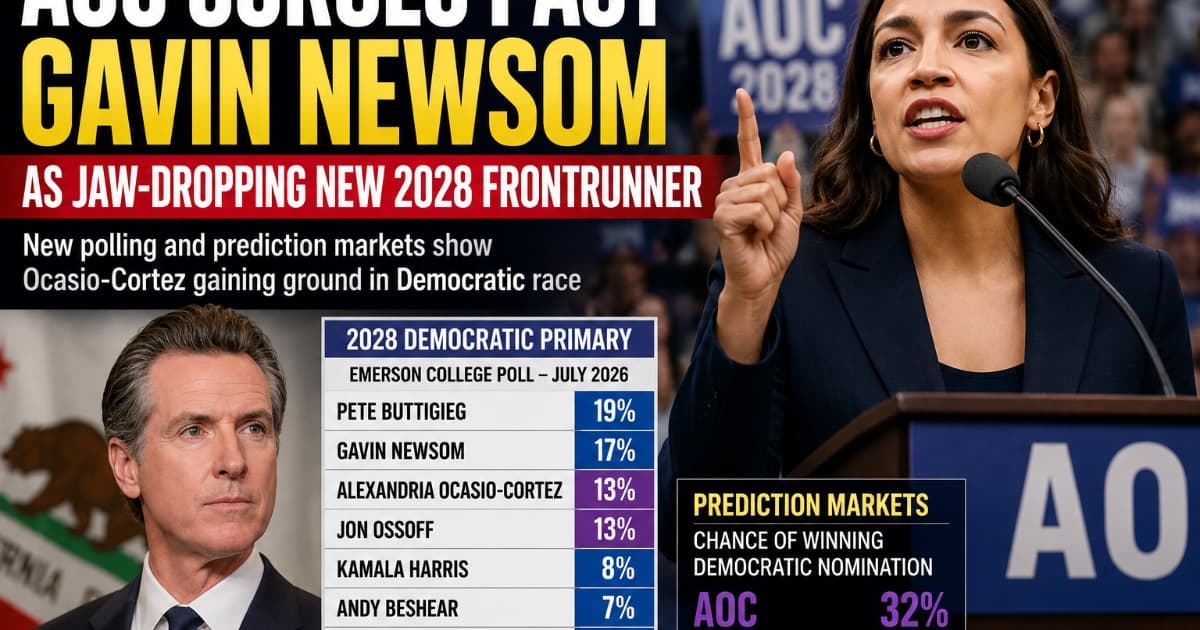
World
AOC Surges in 2028 Race, Challenging Gavin Newsom as Democratic Frontrunner Speculation Explodes
By The Daily Ledger10 min read47 views
Rep. Alexandria Ocasio-Cortez is emerging as an increasingly serious potential contender for the 2028 Democratic presidential nomination, gaining strength in early-state polling and even moving ahead of California Gov. Gavin Newsom in some prediction-market measures. But national polling remains highly unsettled, with Pete Buttigieg, Newsom, AOC and other Democrats competing for an early advantage.
AOC Surges in 2028 Race, Challenging Gavin Newsom as Democratic Frontrunner Speculation Explodes
Rep. Alexandria Ocasio-Cortez is increasingly being discussed as a serious contender for the 2028 Democratic presidential nomination, as new polling, prediction-market activity and growing national attention fuel speculation about a possible run for the White House.
The New York congresswoman, widely known as AOC, has not announced a presidential campaign.
But that has done little to slow speculation.
Recent political developments have put Ocasio-Cortez in an increasingly prominent position among Democrats considering their future after President Donald Trump's second term.
In some measures of the developing 2028 contest, AOC has even moved ahead of California Gov. Gavin Newsom — long considered one of the Democratic Party's most formidable prospective presidential candidates.
But the picture is more complicated than declaring AOC the new national frontrunner.
National polling still shows a highly competitive Democratic field, and different polls produce dramatically different results.
AOC's 2028 Momentum Is Growing
Ocasio-Cortez has spent years as one of the Democratic Party's most recognizable progressive figures.
Now the question is whether that national profile could translate into a presidential campaign.
Recent developments suggest Democrats are increasingly taking the possibility seriously.
AOC has attracted substantial attention in New Hampshire, traditionally one of the country's most politically important presidential-primary states.
Recent polling there has placed her at the top or near the top of the prospective Democratic field.
One survey put Ocasio-Cortez at 22% among likely Democratic primary voters, narrowly ahead of Pete Buttigieg.
That result immediately attracted attention because early-state strength can be enormously valuable during presidential nomination contests.
AOC Moves Ahead of Newsom in Some Prediction Markets
Prediction markets have added another dimension to the story.
Traders attempting to forecast the eventual 2028 Democratic nominee have recently increased their expectations for Ocasio-Cortez.
At points, AOC's implied chances of securing the Democratic nomination have moved above Newsom's.
That represents a significant shift in perception.
Newsom has spent years building a national political operation and has frequently been discussed as a likely future presidential candidate.
Seeing AOC challenge or surpass him in any widely followed political forecasting market therefore generates headlines.
But prediction markets should not be confused with voter polls.
They measure what traders believe is likely to happen, not necessarily whom Democratic voters currently support.
National Polling Tells a Different Story
The latest national polling demonstrates why it is still far too early to crown any Democratic frontrunner.
A July Emerson College Polling survey found former Transportation Secretary Pete Buttigieg leading the prospective Democratic primary field with 19%.
Newsom followed at 17%.
Georgia Sen. Jon Ossoff and Ocasio-Cortez were tied at 13%.
Former Vice President Kamala Harris received 8%, followed by Kentucky Gov. Andy Beshear at 7% and Pennsylvania Gov. Josh Shapiro at 5%.
Those numbers show a fragmented Democratic electorate.
No candidate is remotely close to majority support.
And with the first 2028 primary still far away, the rankings could change repeatedly.
Why AOC Could Be Formidable
Ocasio-Cortez possesses several advantages that distinguish her from many potential Democratic candidates.
The first is name recognition.
Few members of Congress have achieved her level of national visibility.
Since defeating longtime Democratic Rep. Joe Crowley in a stunning 2018 primary upset, AOC has built an enormous political following.
She communicates directly with millions of people through social media and frequently generates national attention without depending on traditional television networks.
That gives her something presidential candidates spend enormous amounts of money trying to create: a direct relationship with a large audience.
Her Grassroots Following Could Matter
AOC also possesses a powerful grassroots fundraising network.
Her political brand has traditionally emphasized small-dollar donations rather than dependence on wealthy donors.
That model could prove valuable in a presidential primary.
Modern campaigns require enormous sums of money.
But a candidate capable of repeatedly raising smaller contributions from hundreds of thousands of supporters can build a financially sustainable national operation.
Bernie Sanders demonstrated the potential of that model during his presidential campaigns.
Ocasio-Cortez could inherit significant parts of the progressive coalition Sanders helped build.
The Bernie Sanders Connection
AOC's relationship with Sen. Bernie Sanders is central to understanding her political position.
Sanders transformed progressive politics during his 2016 and 2020 presidential campaigns.
He demonstrated that proposals once considered outside the Democratic mainstream could attract millions of voters.
Ocasio-Cortez emerged from the same progressive movement.
The two have appeared together at political events and share positions on several major economic issues.
As Sanders moves toward the later stages of his political career, many progressives increasingly view AOC as a potential national successor.
A presidential campaign would test whether she can expand that movement beyond Sanders' traditional coalition.
AOC Is Also Trying to Broaden Her Image
One of the most interesting developments surrounding Ocasio-Cortez is her effort to communicate with voters beyond her traditional progressive base.
She has recently attracted enormous attention through unusually personal social-media posts discussing her decision to freeze her eggs.
The videos generated millions of views and sparked debate across the political spectrum.
Supporters praised her openness about fertility and the challenges women face when balancing careers and family planning.
Critics accused her of using a personal subject to build a broader political brand.
Whatever the motivation, the episode demonstrated AOC's unusual ability to dominate national political conversation.
Newsom Remains a Powerful Rival
None of this means Gavin Newsom has disappeared.
Quite the opposite.
Newsom remains one of the most politically formidable Democrats in the country.
The California governor has spent years developing relationships with Democratic activists, donors and state parties.
His national political organization has become increasingly visible.
Newsom has raised substantial money for Democratic organizations around the country and has supported state parties in critical presidential battlegrounds and early-primary states.
Those relationships could become extremely valuable if he launches a presidential campaign.
Newsom Is Building an Early-State Network
Newsom's activity extends far beyond California.
He has helped Democratic organizations in states that will matter enormously in 2028.
That includes South Carolina, which Democrats have now selected as the first state in their 2028 presidential primary calendar.
Nevada, New Hampshire, New Mexico, Michigan and Virginia will follow.
Newsom's fundraising and political travel increasingly resemble the groundwork traditionally laid by prospective presidential candidates.
He has not formally declared a campaign.
But virtually every major Democratic political player understands the possibility.
South Carolina Changes the Equation
The Democratic National Committee's new 2028 primary calendar could significantly affect both Newsom and AOC.
South Carolina will vote first.
That places enormous importance on Black Democratic voters, who form a critical part of the state's primary electorate.
Candidates who rely primarily on young progressive voters will need to demonstrate that they can build broader coalitions.
That could be one of AOC's biggest tests.
Strong performance among young voters and progressives can create momentum.
But winning a Democratic presidential nomination requires support across racial, geographic, ideological and generational groups.
AOC's Biggest Challenge: Expanding Her Coalition
Ocasio-Cortez is one of America's most famous progressive politicians.
That is both an advantage and a liability.
Her supporters see her as authentic, energetic and willing to challenge powerful economic interests.
Her critics see her democratic socialist politics as too far left for a national electorate.
A presidential campaign would force AOC to answer a fundamental question:
Can she persuade Democrats who admire her communication skills but disagree with parts of her ideology?
That means winning over moderates.
It means attracting older voters.
It means expanding support among Black and Latino Democrats.
And eventually, if she became the nominee, it would mean appealing to independents.
Her Age Could Become an Advantage
AOC would also represent a dramatic generational change.
Born in 1989, she would be 39 during the 2028 election.
That would make her one of the youngest serious presidential contenders in modern American history.
For Democrats frustrated by decades of leadership dominated by older politicians, that could be extremely attractive.
AOC could present herself as the candidate of a new political generation.
Her ability to communicate through social media would reinforce that argument.
But Youth Alone Doesn't Win Elections
A generational message carries risks.
Older Americans vote at higher rates than younger Americans.
Presidential candidates cannot rely exclusively on voters under 40.
AOC would therefore need to convince older Democrats that her policies and leadership style could deliver stability as well as change.
That challenge may explain why her recent public communication appears increasingly focused on personal experiences and broader life issues rather than exclusively ideological politics.
Buttigieg Cannot Be Ignored
The AOC-versus-Newsom framing also overlooks another important candidate.
Pete Buttigieg currently leads the latest Emerson national Democratic primary survey.
The former transportation secretary has already run for president.
He possesses a national donor network, significant television experience and familiarity with presidential campaigning.
His 19% showing in the Emerson survey places him narrowly ahead of Newsom.
That makes the early Democratic race at least a three-way conversation — and potentially much larger.
Jon Ossoff Is Emerging Too
Georgia Sen. Jon Ossoff is another Democrat gaining attention.
Emerson places him alongside AOC at 13%.
His profile differs considerably from hers.
Ossoff represents a competitive Southern state and could potentially argue that his electoral experience gives Democrats a path to voters beyond strongly Democratic areas.
His presence further demonstrates how open the field remains.
Nobody Has Declared Victory — Or Even Officially Entered
The most important fact about the 2028 Democratic primary is also the easiest to forget.
It is extremely early.
Most of the leading prospective candidates have not formally entered the race.
Campaign organizations have not been fully built.
Debates have not begun.
Major endorsements remain unsettled.
Voters have not experienced the intense scrutiny that accompanies an actual presidential campaign.
A candidate who looks formidable in 2026 could collapse in 2027.
Someone currently polling in single digits could become the nominee.
Presidential primaries have produced surprises many times before.
Could AOC Actually Run?
Ocasio-Cortez has deliberately left that possibility open.
She has acknowledged that she is evaluating her political future.
Her options could include seeking the presidency.
Another possibility is challenging Senate Democratic leader Chuck Schumer for his New York Senate seat in 2028.
Those are very different paths.
A Senate campaign would allow AOC to remain influential in national politics while building additional legislative experience.
A presidential campaign would immediately place her at the center of the Democratic Party's debate over its future.
Her eventual decision could reshape both races.
Democrats Are Searching for Their Post-Trump Identity
The developing 2028 contest is about more than individual personalities.
Democrats are debating what kind of party they want to become after Trump's second presidency.
One faction believes Democrats need a younger, more populist economic message capable of energizing voters who feel ignored by traditional institutions.
AOC could represent that approach.
Another faction believes the party needs executives with broader governing experience and an ability to compete aggressively with Republicans.
Newsom could make that argument.
Others may prefer Buttigieg's technocratic style, Ossoff's generational appeal or a governor such as Beshear or Shapiro with experience winning politically competitive states.
The primary will eventually determine which theory Democratic voters prefer.
Bottom Line
Alexandria Ocasio-Cortez's position in the developing 2028 Democratic presidential contest has strengthened significantly.
She is performing strongly in important early-state polling.
Prediction markets have at times moved her ahead of Gavin Newsom.
Her national profile continues to grow.
And speculation about a presidential campaign is becoming increasingly difficult to dismiss.
But calling AOC the undisputed national Democratic frontrunner would go beyond what current polling shows.
The latest Emerson national survey has Pete Buttigieg at 19%, Gavin Newsom at 17%, and both AOC and Jon Ossoff at 13%.
Newsom also retains a formidable fundraising network and substantial support in several important Democratic constituencies.
The real story is therefore not that AOC has already captured control of the 2028 race.
It is that she increasingly belongs in the top tier of candidates who could.
For a politician who entered Congress less than a decade ago after one of the biggest primary upsets in recent Democratic history, that alone represents a remarkable political rise.
And if AOC ultimately decides to run, the battle between the Democratic Party's progressive movement, establishment networks and emerging generation of leaders could make 2028 one of the most unpredictable Democratic primaries in years.
#Climate


Comments (0)
No comments yet. Be the first to share your thoughts.
Leave a comment
Comments are reviewed before they appear.