 Breaking News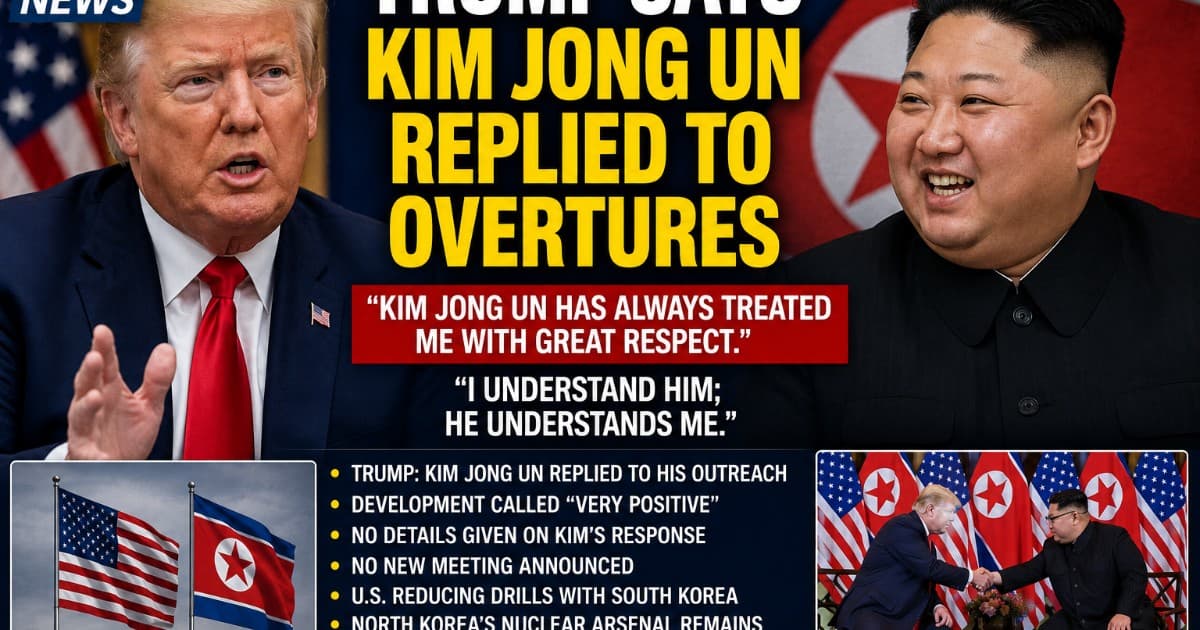
Trump Says Kim Jong Un Responded to His Outreach, Calls Development ‘Very Positive’
By The Daily Ledger7 min read24 views
President Donald Trump says North Korean leader Kim Jong Un has responded to his latest diplomatic outreach, raising the possibility of renewed direct engagement as Washington scales back military exercises with South Korea.
Trump Says Kim Jong Un Responded to His Outreach, Calls Development ‘Very Positive’
President Donald Trump says North Korean leader Kim Jong Un has responded to his latest diplomatic outreach, potentially opening the door to renewed direct engagement between Washington and Pyongyang.
Speaking to reporters in the Oval Office on Monday, August 17, Trump was challenged over whether Kim had actually responded to his efforts to establish contact.
Trump said that he had.
The president provided no details about the nature of Kim's response, but characterized the development as “very positive.”
The comments represent one of the clearest signals yet that Trump is attempting to revive the highly personal diplomacy with Kim that became a defining feature of his first term.
Trump Says Kim Responded
Trump's revelation came after a reporter suggested that the North Korean leader had not answered his overtures.
Trump disputed that characterization.
When pressed on whether Kim had responded, the president confirmed that he had.
Trump did not explain whether the response came directly from Kim, through diplomatic intermediaries or through another communication channel.
The White House also declined to provide additional details.
That means it remains unclear whether formal negotiations are underway or whether another face-to-face meeting is being discussed.
Nevertheless, Trump's confirmation is significant because he has repeatedly expressed interest in reopening communication with the North Korean leader.
Trump Praises His Relationship With Kim
Trump also returned to one of his most familiar arguments about North Korea: that his personal relationship with Kim helps reduce the risk of confrontation.
“Kim Jong Un has always treated me with great respect,” Trump told reporters.
Trump added that the two leaders understand each other, emphasizing the personal rapport they developed during his first presidency.
That relationship represented a dramatic departure from decades of conventional American diplomacy toward North Korea.
Rather than relying exclusively on negotiations between lower-level officials, Trump repeatedly sought direct leader-to-leader engagement.
A Remarkable Diplomatic History
Trump and Kim produced some of the most extraordinary diplomatic images of Trump's first term.
The two leaders first met at a historic summit in Singapore in June 2018.
That meeting marked the first time a sitting American president had met a North Korean leader.
They met again in Hanoi, Vietnam, in February 2019.
The Hanoi summit ended without a comprehensive agreement after the two sides failed to resolve disagreements involving sanctions relief and North Korea's nuclear program.
Trump later met Kim again at the Korean Demilitarized Zone in June 2019.
During that encounter, Trump briefly crossed into North Korean territory, becoming the first sitting U.S. president to do so.
Despite the unprecedented diplomacy, negotiations ultimately failed to produce the denuclearization agreement Washington sought.
Trump Wants to Revive Direct Diplomacy
Since returning to the White House, Trump has repeatedly signaled that he remains interested in talking directly with Kim.
His latest statement suggests those efforts may finally have received some form of response from Pyongyang.
But a response is not the same as an agreement to negotiate.
There has been no official announcement of a summit.
There is also no confirmed timetable for formal negotiations.
For now, Trump's comments indicate that communication may be occurring, while the substance and significance of that communication remain unclear.
U.S.–South Korea Military Drills Become Part of the Story
Trump's comments come at an especially important moment for the Korean Peninsula.
The president recently instructed the Pentagon to substantially reduce joint military exercises with South Korea.
Trump has long criticized the exercises as expensive and provocative.
North Korea has repeatedly condemned the drills as rehearsals for an invasion, while Washington and Seoul maintain that they are defensive exercises necessary for military readiness.
The annual Ulchi Freedom Shield exercises began this week and involve approximately 18,000 South Korean troops.
Trump's decision to reduce aspects of the exercises could therefore serve several objectives simultaneously.
It reduces an activity he has personally criticized for years while potentially creating a more favorable environment for renewed diplomacy with Kim.
Echoes of Trump's First Term
The strategy strongly resembles Trump's approach during his first presidency.
In 2018, Trump suspended major military exercises with South Korea following his Singapore summit with Kim.
The president argued that reducing the drills could lower tensions and create space for diplomacy.
Critics warned that reducing exercises could weaken military readiness and give North Korea a concession without securing meaningful denuclearization.
Those competing arguments are likely to return if Trump again links military exercises to negotiations with Pyongyang.
South Korea Faces a Difficult Balance
The development also places South Korea in a complicated position.
Seoul wants to reduce tensions with North Korea while maintaining a credible defense posture.
South Korean President Lee Jae Myung has advocated dialogue and peaceful coexistence with the North.
At the same time, Seoul continues strengthening its own defense capabilities.
South Korea must therefore balance support for renewed diplomacy with concerns that major reductions in joint exercises could affect military preparedness.
The future of the U.S.–South Korea alliance could become increasingly important if Trump continues changing Washington's military posture on the peninsula.
North Korea's Nuclear Arsenal Remains the Biggest Problem
Personal diplomacy cannot eliminate the central disagreement between Washington and Pyongyang.
North Korea possesses nuclear weapons.
Washington has historically sought the denuclearization of the Korean Peninsula.
Pyongyang, however, has continued developing its nuclear and missile capabilities.
North Korea has little incentive to surrender weapons that its leadership considers essential to national security and regime survival.
That fundamental disagreement helped derail previous Trump-Kim negotiations.
It remains unclear what either side could offer today that would overcome the same obstacle.
North Korea Is in a Stronger International Position
The geopolitical environment has also changed significantly since Trump and Kim last met.
North Korea has developed closer relations with Russia.
Pyongyang has provided military support to Moscow during the war in Ukraine, while Russia and North Korea have expanded cooperation.
Kim also maintains North Korea's crucial relationship with China.
Those relationships may give Pyongyang greater diplomatic and economic flexibility than it possessed during Trump's first round of negotiations.
As a result, Kim may feel less pressure to make major concessions to Washington.
Could Trump and Kim Meet Again?
Another Trump-Kim summit is now an obvious possibility, but it is far from confirmed.
Trump clearly values direct leader-to-leader diplomacy and has repeatedly emphasized his relationship with Kim.
Kim could also see advantages in another meeting with an American president.
A summit would give the North Korean leader enormous international attention and reinforce Pyongyang's longstanding desire to be treated as a major geopolitical actor.
But both sides would have to determine whether another summit could produce results that previous meetings failed to achieve.
Without significant preparation, another high-profile meeting could once again generate historic images without resolving the underlying nuclear dispute.
What Happens Next?
The next development to watch is whether Washington or Pyongyang provides additional information about Kim's response.
If diplomatic contacts expand, lower-level officials could begin preparing the groundwork for direct negotiations.
A meeting between Trump and Kim could eventually follow.
Washington will also have to determine what it wants from renewed talks.
The administration could focus on complete denuclearization, nuclear-arms limitations, missile restrictions, sanctions, regional security or some combination of those issues.
Pyongyang's demands would be equally important.
North Korea has historically sought sanctions relief, security guarantees and changes to the American military presence surrounding the Korean Peninsula.
Bottom Line
President Trump's announcement that Kim Jong Un has responded to his diplomatic outreach represents a potentially important development in U.S.–North Korea relations.
Trump described the response as “very positive” and again emphasized the unusual personal relationship he developed with Kim during his first presidency.
But significant questions remain unanswered.
Trump did not disclose what Kim communicated.
The White House has not announced formal negotiations.
And no new Trump-Kim summit has been confirmed.
Most importantly, North Korea's nuclear arsenal remains the fundamental obstacle that previous rounds of leader-to-leader diplomacy failed to resolve.
For now, Trump's revelation suggests that the communication channel between Washington and Pyongyang may be reopening.
Whether that leads to another historic summit — or another diplomatic dead end — will depend on what happens next.
This article reflects confirmed reporting available on August 18, 2026. Trump has said Kim responded to his outreach, but neither the substance of that response nor plans for a new summit have been publicly disclosed.
Related Stories
Breaking News

Comments (0)
No comments yet. Be the first to share your thoughts.
Leave a comment
Comments are reviewed before they appear.