 Breaking News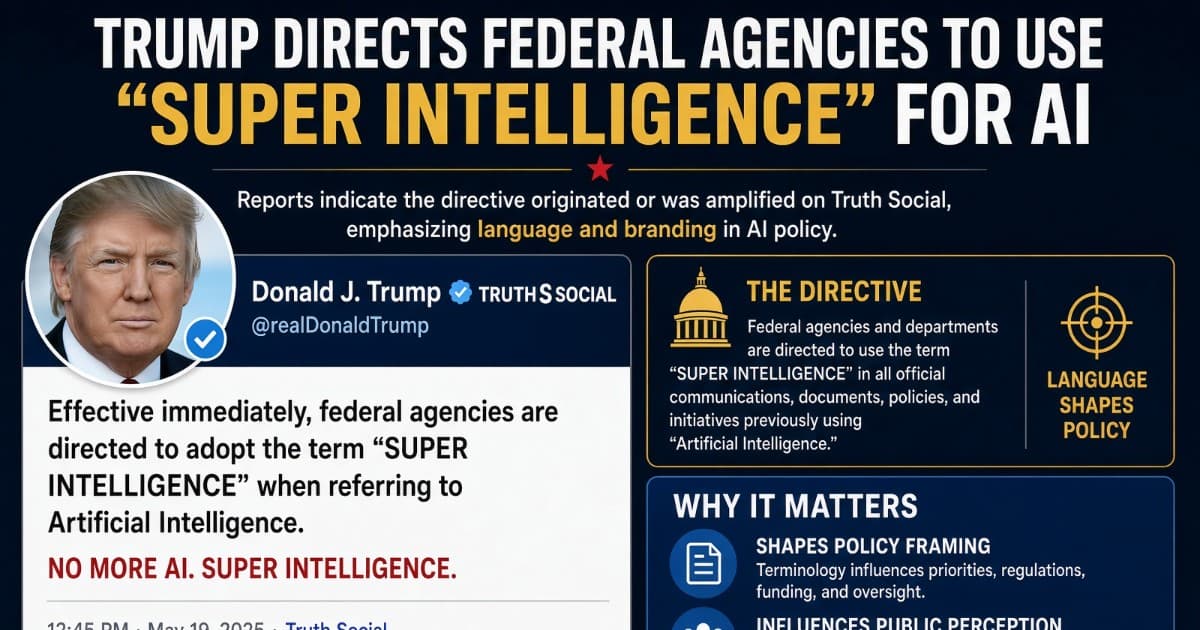
Breaking News
Trump Directs Federal Agencies to Use 'Super Intelligence' in Place of 'Artificial Intelligence'
By The Daily Ledger2 min read3 views
President Trump has ordered U.S. federal agencies to refer to artificial intelligence as 'super intelligence,' a branding shift announced via Truth Social.
Trump Orders Federal Agencies to Rebrand AI as 'Super Intelligence'
President Donald Trump has directed United States federal agencies to use the term "super intelligence" when referring to artificial intelligence, a move that signals the administration's intent to reshape the language surrounding one of the most consequential technologies of the modern era.
The directive, which Trump announced through his Truth Social platform, reflects a broader push by the administration to frame American leadership in artificial intelligence in bold, assertive terms. By replacing the widely accepted shorthand "AI" with "super intelligence," the White House appears to be making a deliberate branding choice aimed at projecting strength and technological dominance.
The terminology shift, however, is likely to raise eyebrows among researchers and technologists. In academic and industry circles, "superintelligence" carries a specific and weighty meaning: it describes a hypothetical, future form of machine cognition that would exceed human intelligence across every domain. The concept remains theoretical and is the subject of long-range forecasting rather than a description of the AI systems currently deployed by governments and companies. Applying the term to today's technology conflates an existing and rapidly developing field with a speculative future state.
For federal agencies, a formal change in terminology is more than semantic. Official language ripples through government contracts, budget requests, legislative language, and inter-agency communications. A directive to adopt a new term could require updates to documentation across departments and may create inconsistencies when agencies coordinate with international partners, research institutions, and private industry, all of which rely on standardized vocabulary.
The announcement continues a pattern of the Trump administration using Truth Social to introduce policy positions before or in place of formal White House communications. The platform has increasingly become a primary channel through which the president signals directives to the public and to executive branch officials.
The move comes as the United States is engaged in an intensifying competition with China and other nations over AI development and standards-setting. The Trump administration has prioritized reducing regulatory friction on AI companies and positioning the country as the undisputed global leader in the technology. Framing that technology as "super intelligence" may be intended to reinforce a narrative of American exceptionalism in the field.
Reaction from the technology community and from members of Congress had not fully crystallized in the immediate aftermath of the announcement. Critics may argue the terminology overstates the current capabilities of AI systems, while supporters of the administration are likely to view it as a confident assertion of American ambition in a field that will shape economic and national security outcomes for decades to come.
##DonaldTrump #TrumpNews #BreakingNews #HotNews #USA #AmericanNews #5000Dollars #StimulusCheck #GovernmentNews #USNews #LatestNews #TrumpAnnouncement #AmericanCitizens #FinancialUpdate #NewsToday##Trump #LindsayClancy #PardonRequest #Mistrial #MurderTrial #Massachusetts #CourtNews #LegalNews #PostpartumPsychosis #CrimeNews #BreakingNews #USNews #TrialUpdate #Retrial #CurrentEvents

Comments (0)
No comments yet. Be the first to share your thoughts.
Leave a comment
Comments are reviewed before they appear.