 Breaking News
Trump Confirms No Talks With Iran, Says Strait of Hormuz Is De-Mined and Open
By The Daily Ledger11 min read48 views
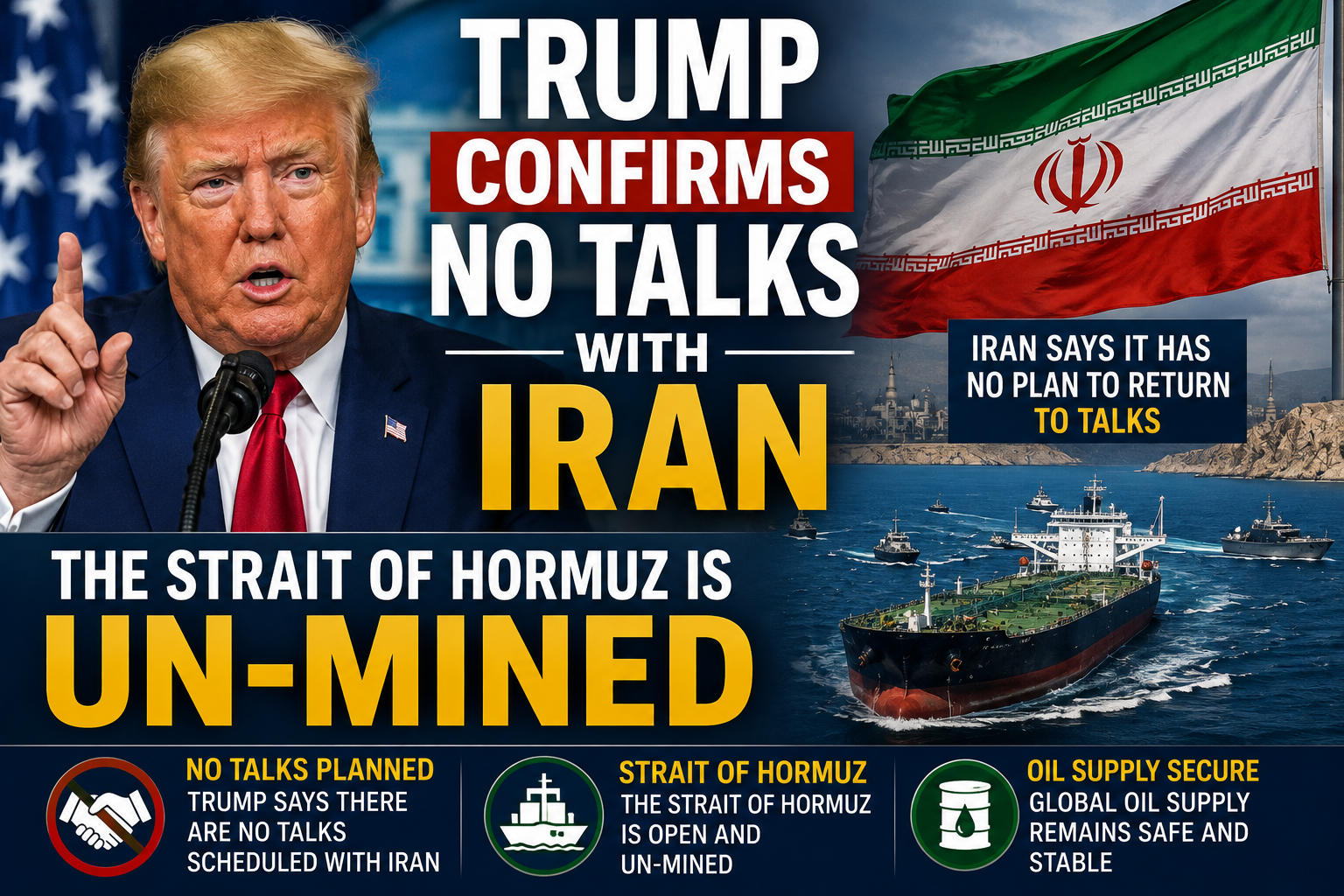
President Donald Trump says the United States is no longer negotiating with Iran and that no new talks are scheduled, while declaring that naval mines have been cleared from the Strait of Hormuz. Tehran disputes Washington’s portrayal of the strategic waterway, insisting restrictions will remain until the United States fulfills key conditions of a June agreement.
Trump Confirms No Talks With Iran, Says Strait of Hormuz Is De-Mined and Open
President Donald Trump says the United States is no longer engaged in negotiations with Iran and that no additional talks are scheduled, marking another major deterioration in efforts to find a diplomatic solution to the conflict.
At the same time, Trump says the strategically vital Strait of Hormuz has been cleared of naval mines and is now “open and operating.”
But Iran is presenting a sharply different picture.
Tehran says the strait will remain effectively closed or restricted until Washington fulfills conditions contained in an interim agreement reached in June.
The conflicting declarations have created fresh uncertainty over one of the most important waterways in the global economy.
And despite Trump's assertion that Hormuz is open, commercial shipping remains significantly disrupted.
Trump Says There Are No Talks With Iran
Trump announced Tuesday that Washington and Tehran are not currently negotiating.
He also said there are no additional talks scheduled.
The statement represents a significant change from earlier periods in the conflict when Trump repeatedly suggested negotiations were underway or about to begin.
For months, diplomacy has repeatedly started, stopped and shifted between direct contacts and mediation involving regional governments.
Now Trump is publicly signaling that the negotiating track has stalled.
The development comes immediately after the expiration of a 60-day window intended to produce a broader agreement between Washington and Tehran.
That deadline passed without a comprehensive settlement.
Trump Says Hormuz Has Been De-Mined
Trump simultaneously made a major claim about the Strait of Hormuz.
According to the president, naval mines in the waterway have been removed.
He described the strait as open and operational.
That would be enormously significant if normal commercial traffic ultimately returns.
Hormuz has been at the center of the conflict because of its importance to global energy supplies.
Iran previously deployed mines and other military capabilities around the waterway as part of its strategy against American pressure.
The United States has conducted operations aimed at countering that threat.
Trump now says those mines have been eliminated.
The U.S. Blockade Remains
Although Trump says Hormuz itself is open, the U.S. naval blockade targeting Iran remains in effect.
That creates an important distinction.
Washington is arguing that international shipping can move through the strategic waterway while simultaneously preventing prohibited maritime traffic from reaching Iranian ports.
Trump has repeatedly described the blockade as evidence of American military control over the region.
He has argued that U.S. naval forces — rather than Iran — ultimately determine which vessels can operate freely.
That position has become central to his strategy.
Iran Says the Strait Is Still Restricted
Tehran disputes Trump's description of the situation.
Iranian officials say the Strait of Hormuz will remain restricted until the United States fulfills the conditions of an interim agreement negotiated earlier this summer.
Iran's position therefore directly challenges Washington's declaration that the waterway has returned to normal operation.
Iran has demanded several major concessions.
They include lifting the American blockade on Iranian ports, easing oil sanctions, releasing frozen Iranian assets and ending military threats and operations against Iran.
Washington has not accepted those demands.
That leaves both countries claiming fundamentally different versions of what should happen next.
The June Agreement Has Largely Collapsed
The current confrontation traces partly to a memorandum reached on June 17.
The arrangement was supposed to create a 60-day period in which Washington and Tehran could negotiate a broader settlement.
That settlement was expected to address several of the most difficult issues between the two governments.
Iran's nuclear program was one.
The Strait of Hormuz was another.
Sanctions and maritime access were also central.
But the agreement quickly encountered problems.
Both governments accused the other of violating its obligations.
The United States eventually declared the agreement effectively finished.
Iran subsequently suspended its participation.
The 60-day deadline has now expired without the comprehensive peace agreement negotiators originally sought.
Why Hormuz Matters So Much
The Strait of Hormuz is a narrow maritime passage connecting the Persian Gulf with the Gulf of Oman and the Arabian Sea.
Iran lies along its northern side.
Oman occupies territory along the southern side.
Its geographic size is small compared with its economic importance.
Historically, roughly one-fifth of global oil and liquefied natural gas trade has moved through or near this corridor.
Major energy exporters depend on it to reach international markets.
That includes Saudi Arabia, Iraq, Kuwait, Qatar and the United Arab Emirates.
A disruption in Hormuz therefore does not remain a regional problem for long.
It can quickly become a global economic problem.
Shipping Has Not Returned to Normal
This is where Trump's statement requires important context.
Calling the strait “open” does not mean normal shipping conditions have returned.
Commercial traffic remains significantly below historical levels.
Shipping companies continue to evaluate security risks.
Insurers must consider the possibility of attacks.
Military activity remains intense.
And Iran continues asserting that it has the ability to restrict traffic.
Recent incidents have reinforced those concerns.
A projectile struck a vessel operating around the strait, causing damage and casualties, according to reporting on the regional situation.
That demonstrates that the physical removal of mines does not eliminate every threat facing commercial shipping.
De-Mining Does Not Equal Complete Safety
Naval mines are only one component of maritime security.
Even if U.S. forces have successfully cleared mines from key shipping lanes, vessels can still face other dangers.
Those could include drones.
Missiles.
Small attack craft.
Sabotage.
Seizure attempts.
Or renewed mine-laying.
The security environment therefore remains extremely volatile.
Shipping companies are likely to judge conditions based on actual risk rather than political declarations from either Washington or Tehran.
Iran's Conditions
Iran says Washington must satisfy the conditions established under the June arrangement before normal passage can resume.
Among Tehran's demands are changes to American sanctions.
Iran wants greater access to frozen financial assets.
It wants restrictions on Iranian oil exports eased.
It also wants Washington to reduce military pressure.
Those demands go directly to the heart of Trump's strategy.
The administration has been using economic sanctions and military power precisely because it believes those tools give Washington leverage over Tehran.
Giving them up without major Iranian concessions would undermine that strategy.
Washington Wants Iranian Concessions First
The United States approaches the dispute from the opposite direction.
Trump has repeatedly argued that Iran must make major concessions before Washington reduces pressure.
Preventing Iran from developing nuclear weapons remains one of his central stated objectives.
The administration also wants to reduce Tehran's ability to threaten international shipping.
Washington therefore sees sanctions and the blockade as leverage.
Iran sees removing those measures as a prerequisite for progress.
That creates a classic negotiating deadlock.
Each side wants the other to move first.
Neither currently appears willing to do so.
Confusion Over Whether Diplomacy Is Really Dead
Trump's declaration that no talks are occurring adds another layer of uncertainty.
Different officials and intermediaries have offered conflicting descriptions of diplomatic contacts during recent weeks.
Trump's son-in-law Jared Kushner, who has participated in diplomatic efforts, has previously indicated that communications remained active.
Regional governments have also continued attempting to mediate.
Oman remains particularly important.
It has longstanding relations with both Washington and Tehran and has repeatedly served as a diplomatic bridge between the two.
But Trump's latest statement suggests that whatever indirect communication may continue, there is currently no formal U.S.-Iran negotiating process scheduled.
Oman Has Become Part of the Crisis
Oman's role has become increasingly controversial.
Muscat has been negotiating with Iran over possible arrangements governing commercial shipping through Hormuz.
Those discussions have angered Washington.
Trump has even threatened military action against Oman if it interferes with American objectives.
That is an extraordinary development because Oman has traditionally been a U.S. partner and a useful intermediary with Iran.
The disagreement demonstrates how the Hormuz crisis is reshaping relationships throughout the Gulf.
Iran Signals a More Aggressive Posture
Tehran has also hardened its rhetoric.
A senior Iranian official has said the country could adopt a fully offensive military posture as diplomacy breaks down.
That warning matters because Iran retains substantial military capabilities around the Persian Gulf.
Even if mines have been removed from current shipping lanes, Tehran could potentially attempt to disrupt maritime traffic again.
That possibility means de-mining cannot necessarily be treated as a permanent solution.
Maintaining safe navigation would require preventing new threats from emerging.
Oil Markets React
Energy markets are closely watching every development.
Oil prices rose for a third consecutive session Tuesday as expectations for a U.S.-Iran settlement weakened.
Brent crude traded above $91 a barrel, while U.S. West Texas Intermediate was around $85 in Tuesday trading.
The reason is straightforward.
Markets price risk.
If traders believe Hormuz could remain disrupted, they anticipate potential reductions in global energy supply.
That pushes prices higher.
If credible evidence emerges that normal shipping can safely resume, some of that geopolitical risk premium could disappear.
Why Consumers Should Care
The consequences can eventually reach ordinary consumers far from the Middle East.
Higher crude-oil prices can contribute to higher gasoline prices.
Transportation becomes more expensive.
Airlines face higher fuel costs.
Shipping companies pay more.
Businesses may eventually pass some of those costs to customers.
Energy prices can also influence inflation.
That is why a relatively narrow stretch of water between Iran and Oman can have economic consequences across the United States, Europe and Asia.
Trump's Larger Hormuz Strategy
Trump has increasingly framed the Strait of Hormuz as something the United States effectively controls.
He has pointed to the naval blockade as proof of American dominance in the waterway.
More controversially, he has recently suggested declaring the strait U.S. territory and posted imagery depicting it as such.
Those claims do not themselves change internationally recognized sovereignty.
But they demonstrate how central control of Hormuz has become to Trump's Iran strategy.
Washington does not merely want mines removed.
It wants to ensure Tehran cannot use the strait as permanent leverage over the global economy.
Iran Sees Hormuz as Strategic Leverage
Iran views the issue very differently.
Its geographic position around Hormuz is one of its most powerful strategic advantages.
The United States possesses overwhelming conventional military power.
Iran cannot easily match American aircraft carriers, bombers or global military infrastructure.
But Tehran can threaten a narrow waterway through which enormous quantities of energy normally pass.
That creates asymmetric leverage.
Disrupting Hormuz can impose economic costs on countries that are not directly involved in the conflict.
For Iran, surrendering that leverage without receiving major concessions would be strategically costly.
The Two Sides Remain Far Apart
That explains why diplomacy has repeatedly failed.
Washington wants Iran to surrender important military and nuclear capabilities before major American pressure is lifted.
Iran wants sanctions relief, financial access and security guarantees before surrendering leverage.
Both sides believe time can work in their favor.
Trump believes economic and military pressure will eventually force Tehran to accept American terms.
Iran appears to believe that disruption to global energy markets will increase international pressure on Washington to compromise.
Those strategies cannot continue indefinitely without increasing the risk of further confrontation.
What Happens Next?
Several developments now deserve close attention.
The first is actual shipping data.
If commercial vessels begin returning to Hormuz in substantial numbers, Trump's declaration that the strait is open will gain practical significance.
If traffic remains severely depressed, Iran's claim that the waterway remains effectively restricted will better describe conditions on the ground.
The second is military activity.
Any new Iranian mine-laying operation, missile attack or vessel seizure could rapidly reverse progress made by U.S. de-mining operations.
The third is diplomacy.
Trump says no talks are scheduled.
But regional mediators have repeatedly attempted to revive negotiations after previous breakdowns.
Another diplomatic opening therefore remains possible.
A Dangerous Standoff
For now, Washington and Tehran remain locked in a dangerous contradiction.
Trump says Hormuz is open.
Iran says it remains restricted.
Trump says there are no talks.
Regional governments continue searching for diplomatic options.
The United States says its blockade will remain.
Iran demands that blockade be removed.
Neither side appears prepared to concede.
That leaves the world's most important energy chokepoint trapped between military control and diplomatic stalemate.
Bottom Line
President Donald Trump says there are no negotiations currently taking place with Iran and no additional talks are scheduled.
He also says U.S. operations have removed naval mines from the Strait of Hormuz and that the waterway is now “open and operating.”
Those are significant claims.
But they do not mean the Hormuz crisis is over.
Iran says the strait will remain restricted until Washington fulfills conditions from the June interim agreement, including sanctions relief, access to frozen assets and changes to American military pressure.
Commercial shipping also remains substantially disrupted.
Meanwhile, oil prices are rising as hopes for a diplomatic settlement fade.
The clearest conclusion is therefore more complicated than either government's headline.
The mine threat may have been substantially reduced in key areas, according to Trump, but normal commercial navigation has not yet been convincingly restored.
And with Washington and Tehran no longer formally negotiating, the possibility of another escalation remains dangerously high.
Related Stories
Breaking News

Comments (0)
No comments yet. Be the first to share your thoughts.
Leave a comment
Comments are reviewed before they appear.