 Breaking News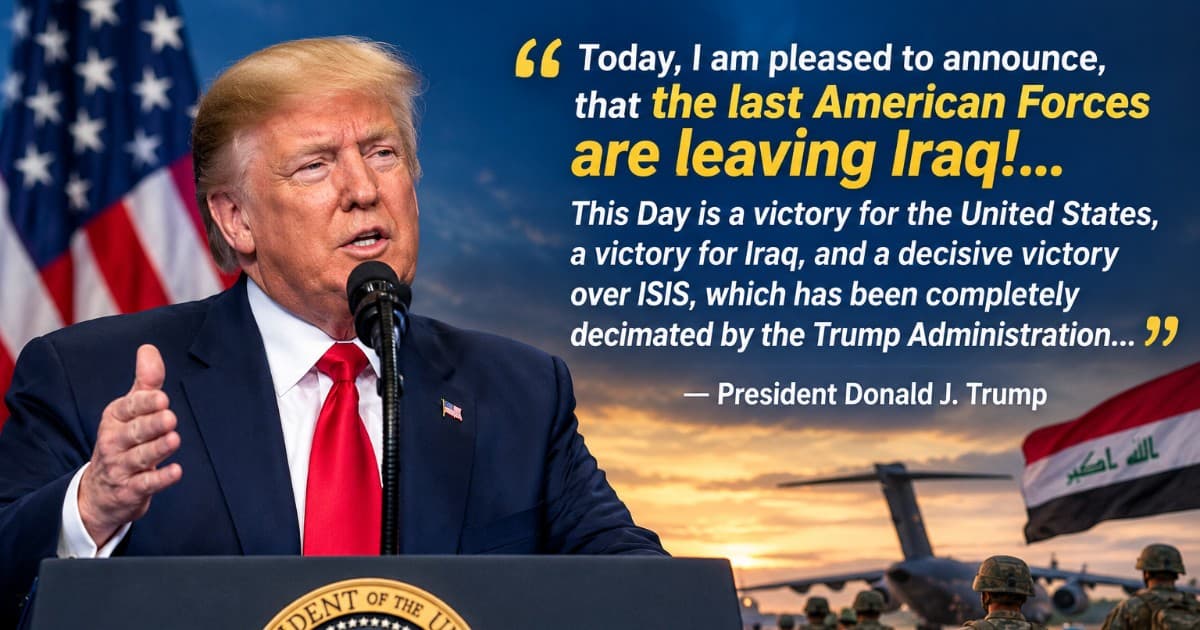
Breaking News
Today, I am pleased to announce, that the last American Forces are leaving Iraq
By The Daily Ledger2 min read8 views
President Donald Trump announced that the last U.S. forces are leaving Iraq, marking the end of the U.S.-led coalition’s military mission there. Trump described the departure as a victory for the United States and Iraq and credited his administration with the defeat of ISIS’s territorial caliphate. The withdrawal concludes more than two decades of U.S. military involvement in Iraq, while questions remain about Iraq’s future security and the continued threat posed by extremist groups.
President Donald Trump announced that the last American forces are leaving Iraq, declaring the conclusion of the coalition mission a major moment for both countries.
In his statement, Trump said the departure represents “a victory for the United States, a victory for Iraq, and a decisive victory over ISIS.” He also argued that the mission accomplished its objective of defeating ISIS's territorial caliphate.
The final withdrawal comes after more than two decades of U.S. military involvement in Iraq. Reuters reported that the last troops departed from Erbil, bringing the military chapter of the coalition's Iraq mission to an end. The Fight Against ISIS
The U.S.-led coalition entered Iraq in 2014 after ISIS captured large areas of Iraq and Syria and declared its so-called caliphate.
Trump emphasized that the organization no longer controls the territory it once held, describing that outcome as a central achievement of the U.S. campaign.
At the same time, the end of the coalition mission does not necessarily mean that the threat from ISIS has disappeared. Reuters reported concerns that dormant Islamic State elements could attempt to exploit changes in Iraq's security environment.
A New Chapter for Iraq
The withdrawal places greater responsibility for national security on the Iraqi government and its security forces.
Supporters of the departure view it as an important step toward Iraqi sovereignty, while some analysts have warned about possible security gaps and increased influence by Iran-backed armed groups.
The withdrawal agreement itself was reached in 2024, with the final implementation taking place during Trump's presidency.
What Comes Next?
The end of the U.S. military mission represents a significant transition for Iraq and the broader Middle East.
The central question now is whether Iraqi security forces can maintain stability, prevent a resurgence of ISIS and manage competing regional influences without a permanent U.S. military presence.
For the United States, the departure closes another major chapter in a conflict that began with the 2003 invasion and evolved through multiple military missions and changing strategic objectives.
President Trump's announcement marks the formal end of a long American military presence in Iraq — while the security consequences of the withdrawal will continue to be closely watched.
Comments (0)
No comments yet. Be the first to share your thoughts.
Leave a comment
Comments are reviewed before they appear.