 Breaking News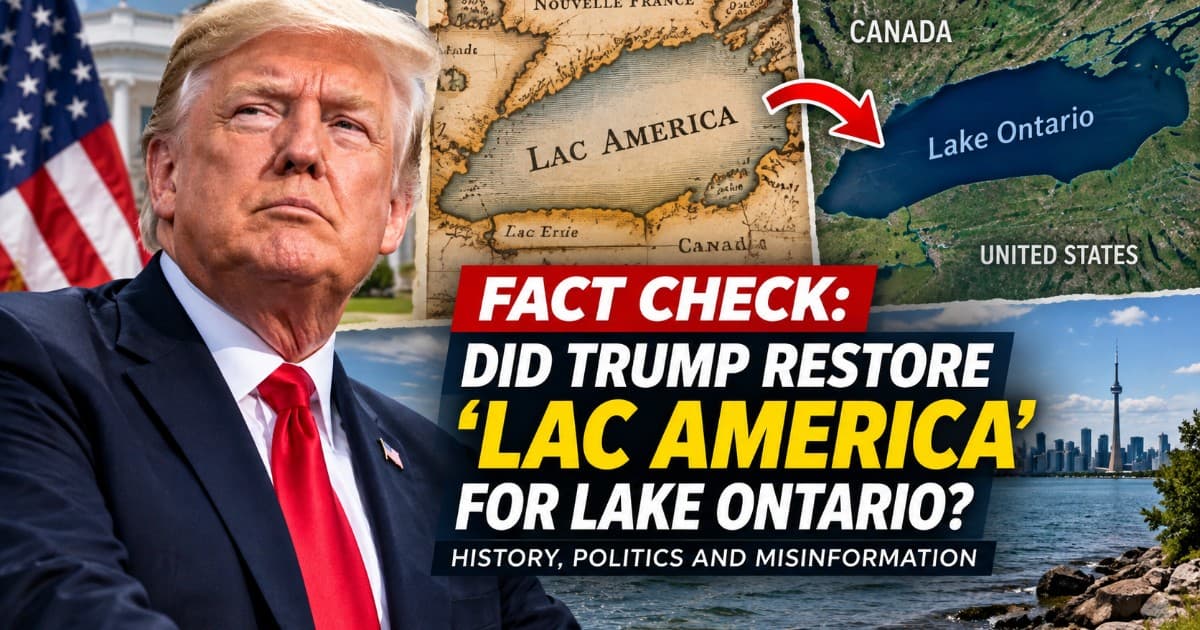
No, Trump Did Not Rename Lake Ontario — Here's What That Old Map Actually Shows
By The Daily Ledger2 min read9 views
A viral claim that Trump renamed Lake Ontario to 'Lac America' based on an old map is drawing scrutiny from fact-checkers and historians.
Fact Check: Did Trump Restore an Old Name for Lake Ontario?
A claim circulating on social media asserts that President Donald Trump moved to rename Lake Ontario, one of the five Great Lakes, reverting it to a name — 'Lac America' — purportedly shown on a 17th-century map. Fact-checkers and historians have been examining whether either part of that claim holds up: the modern political action and the historical precedent used to justify it.
As of available public records, no executive order, presidential memorandum, or directive from the U.S. Board on Geographic Names has been issued formally renaming Lake Ontario. The Board on Geographic Names is the federal body that holds authority over official U.S. place name designations, and major changes to landmark geographic names would ordinarily pass through that process.
The claim appears to draw energy from a real and documented pattern. During his presidency, Trump has expressed interest in renaming certain geographic features for symbolic or nationalist reasons. His administration directed federal agencies to refer to the Gulf of Mexico as the Gulf of America, a move that applied to U.S. government usage without altering the internationally recognized name. That precedent appears to have made similar claims about other bodies of water easier for some audiences to accept at face value.
The historical dimension of the claim introduces a separate layer of scrutiny. Early European cartographers produced maps of the Great Lakes region throughout the 17th century, many of them inconsistent with one another in both geography and naming. French explorers and missionaries were among the first to document the lakes in detail, and the names they used drew on Indigenous languages as well as descriptive terms. Whether any authenticated map from that era labels Lake Ontario as 'Lac America' is a question historians and archivists have been asked to weigh in on, and the label would be considered unusual by scholars of the period.
The situation is further complicated by Lake Ontario's geography. The lake straddles the border between the United States and New York State to the south and the Canadian province of Ontario to the north. Any unilateral renaming by the U.S. federal government would carry no binding authority over Canadian usage or international cartographic standards, meaning the practical effect of such an action would be limited to American federal documents.
The viral spread of the claim follows a pattern familiar to fact-checkers who monitor stories at the intersection of Trump policy and geographic or symbolic nationalism. Dramatic-sounding announcements — particularly those with a historical hook — tend to travel quickly before the underlying details are examined.
Authorities on early American cartography and representatives familiar with the Board on Geographic Names' recent actions are best positioned to offer a definitive assessment of both the historical map question and the current policy record.


Comments (0)
No comments yet. Be the first to share your thoughts.
Leave a comment
Comments are reviewed before they appear.