 Breaking News
Breaking News
(-)🚨 Judge Tosses Wolff Suit, Clearing Path For $1B Melania Claim
By The Daily Ledger14 min read120 views
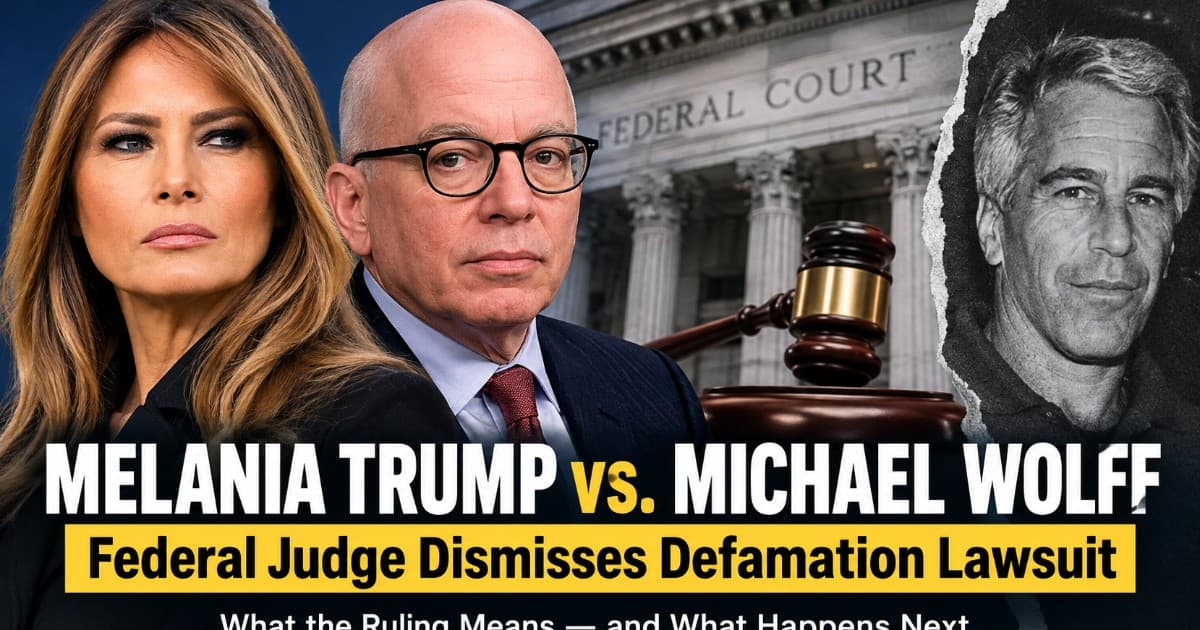
A federal judge has dismissed journalist Michael Wolff’s lawsuit against First Lady Melania Trump, criticizing his legal strategy as an inappropriate attempt to use the courts. The dispute stems from Melania’s threat to pursue a $1 billion defamation lawsuit over statements linking her to Jeffrey Epstein. While Melania denies the allegations and vows to defend her reputation, Wolff argues that his comments were taken out of context or constitute protected speech. The judge’s decision did not determine whether Wolff’s statements were defamatory. Wolff subsequently appealed the dismissal, keeping the high-profile legal dispute alive.
Melania Trump vs. Michael Wolff: What Happened in the Defamation Lawsuit? The main point of this story is that a federal judge dismissed journalist Michael Wolff’s lawsuit against First Lady Melania Trump without deciding the underlying dispute over whether his statements about her were defamatory. The judge said the case had been brought to federal court in an inappropriate way and should be litigated through the proper legal process.
The dispute involves allegations concerning Melania Trump, journalist Michael Wolff’s comments about her relationship with Jeffrey Epstein, and competing claims about whether legal threats are being used to defend a reputation or intimidate critics.
Here is a detailed breakdown of the case, the judge’s decision, the arguments from both sides, and the political implications.
- Who are the people involved?
- Melania Trump: The first lady, who has publicly denied having an association with Jeffrey Epstein and has objected to statements she says damage her reputation.
- Michael Wolff: A journalist and author known for reporting and writing books about Donald Trump and his administration. He argues that some of his statements about Melania Trump were taken out of context or constitute protected opinion.
- Mary Kay Vyskocil: The Manhattan federal judge who dismissed Wolff’s lawsuit from federal court.
- Alejandro Brito: The lawyer who represented Melania Trump in the dispute. The central legal issue is not simply whether the two sides disagree. It is whether the dispute was brought before the correct court through a proper legal procedure—and, separately, whether the statements at issue could legally constitute defamation.
- What happened? The background of the dispute The conflict escalated in October 2025, when Melania Trump’s legal team demanded that Wolff retract statements about her and apologize.
Her lawyer warned that she could pursue a defamation lawsuit seeking $1 billion in damages if Wolff did not comply.
Melania’s legal team argued that Wolff’s statements had caused serious reputational and financial harm.
Wolff responded by filing his own lawsuit in New York state court on October 21, 2025. Rather than waiting for Melania to sue him, he wanted a judge to rule in advance that his statements were not legally defamatory.
He also sought relief under New York's anti-SLAPP law, which is designed to protect people from certain lawsuits intended to suppress public participation and expression.
Melania’s legal team subsequently moved the case into federal court, where Judge Mary Kay Vyskocil considered whether the case should proceed.
The judge ultimately dismissed Wolff’s lawsuit on May 22, 2026. Justia Law Why did Wolff sue first? Wolff's strategy was essentially to obtain legal protection before Melania could bring her threatened defamation action.
He wanted the court to declare that his statements were not actionable libel and to establish that Melania could be responsible for certain legal costs and damages if she pursued claims against him.
His lawsuit also accused the Trumps of using threats of expensive litigation to intimidate critics and discourage unfavorable reporting.
However, the judge found that this approach attempted to get ahead of a potential defamation case rather than allowing the dispute to proceed through the ordinary legal process.
The judge's central objection was to how Wolff brought the case—not a judicial determination that every statement he made was false. Justia Law 3. Why did the federal judge dismiss the lawsuit? The judge's decision is the most important part of this story.
Vyskocil acknowledged that the two parties had a genuine dispute. However, she concluded that Wolff was attempting to use the federal courts in an inappropriate way.
Her ruling involved several important legal considerations. A. Wolff attempted to litigate the dispute preemptively Wolff wanted a court to decide that he had not defamed Melania before the underlying dispute had been resolved through the normal legal process.
The judge considered this an improper attempt to get an early ruling on the legal defenses he might raise if Melania pursued a defamation claim.
In her opinion, she explained that Wolff was effectively asking the court to declare that he should win if Melania sued him.
Her point was that courts generally do not provide the type of advance legal ruling Wolff sought simply because someone threatens to bring a lawsuit. B. The court objected to what it called tactical gamesmanship The judge criticized the way the case had been structured, describing it as an inappropriate exercise in legal maneuvering.
She emphasized that the prominence of the people involved and the controversial subject matter did not justify departing from normal legal procedures.
In other words, neither a journalist nor a public official should be able to obtain special treatment simply because a dispute attracts substantial public attention. C. The judge declined to rule on whether Wolff's statements were defamatory This is a critical distinction.
The court did not decide that all of Wolff's statements were false. Nor did it issue a final ruling that Melania's allegations of defamation were legally established.
Instead, the judge declined to exercise her discretion to hear Wolff's request for a declaratory judgment.
She concluded that the dispute should be handled through the appropriate legal proceedings rather than through Wolff's preemptive lawsuit. Justia Law
Bottom line: Melania prevailed in getting Wolff's lawsuit dismissed, but the dismissal did not establish that every allegation she disputed was false or that every statement Wolff made was defamatory. 4. What exactly were Melania Trump's allegations? The dispute centers on statements Wolff made about Melania, her relationship with Donald Trump, and claims concerning Jeffrey Epstein.
Melania's legal team maintained that certain statements were defamatory and had caused substantial reputational and financial damage.
The legal threat followed public commentary that suggested a connection between Melania and Epstein-related matters.
It is important, however, to distinguish between three different things:
- A claim that someone knew or interacted with another person.
- A claim that someone was involved in handling a political or public-relations issue.
- An allegation that someone participated in criminal activity. These claims are not equivalent.
According to the lawsuit described in the supplied report, Wolff argued that he had not accused Melania of participating in Epstein-related criminal activity. He also maintained that some of his statements had been taken out of context.
The available court reporting does not establish that Melania participated in Epstein's criminal activities. Melania's position Melania has firmly denied having an association with Epstein and has characterized allegations linking her to him as false.
Her legal team argued that the statements at issue harmed her reputation and that she had a right to challenge them through the legal system. Wolff's position Wolff argued that some of his comments constituted protected opinion and that his statements had been misrepresented.
His lawsuit also characterized the threatened litigation as an effort to intimidate critics and discourage public discussion.
These are competing legal positions, not findings that either side has conclusively established all of its claims. The Washington Post 5. What is the connection to Jeffrey Epstein?
Jeffrey Epstein was a convicted sex offender who faced federal sex-trafficking charges when he died in jail in 2019.
His connections to wealthy and influential individuals have remained the subject of extensive public scrutiny.
The Wolff–Melania dispute arose from public statements concerning Melania and Epstein-related matters.
However, the existence of controversy or public speculation does not establish that a person participated in criminal activity.
The lawsuit is principally a dispute about allegedly defamatory statements, threatened litigation, and the legal protections available to people engaged in public commentary. What did Melania say publicly? In an April 2026 statement, Melania called for an end to what she described as false claims linking her to Epstein.
She also called on Congress to hold a public hearing and give victims an opportunity to testify under oath.
Her statement renewed political discussion about the broader Epstein investigation and congressional oversight.
It also attracted responses from lawmakers on both sides of the political divide.
The distinction is important: her public demand for a hearing and her denial of allegations do not, by themselves, resolve the separate legal dispute with Wolff. 6. Why did The Daily Beast retract its article? Another important development was the retraction of a Daily Beast article titled Melania Trump 'Very Involved' in Epstein Scandal: Author.
The article was based on an interview with Wolff. According to the report you supplied, the outlet retracted it after receiving a letter from Melania's lawyer.
Wolff subsequently argued that his comments had been taken out of context.
He maintained that his remarks concerned Melania's alleged behind-the-scenes involvement in the White House's handling of the Epstein-related situation, rather than participation in criminal activity.
This episode illustrates how the legal dispute extended beyond the two principal parties.
It also raises a broader question for media organizations: how should outlets handle controversial claims involving public figures when those claims prompt legal threats?
A retraction is a significant editorial development, but it does not automatically establish that every statement in the original interview was false. Likewise, a journalist's claim that his comments were taken out of context does not independently establish that the publication acted improperly.
Each disputed statement must be evaluated according to its wording, context, supporting evidence, and the applicable law. 7. How did Republicans and Democrats respond? The dispute also attracted political attention because it involved the first lady, Epstein-related controversies, and calls for greater public scrutiny. Republican response Republican Representative Nancy Mace praised Melania for speaking out about Epstein and supporting measures addressing the distribution of fake intimate images.
Mace's comments framed Melania's public statement as an effort to support victims and confront wrongdoing.
However, that praise should not be interpreted as a judicial finding about the specific allegations in Wolff's lawsuit. Democratic response Democratic Representative Robert Garcia called for a public hearing and encouraged House Oversight Committee Chairman James Comer to schedule one.
Garcia's comments reflected the broader political debate about congressional oversight and the handling of Epstein-related matters. Why the political reactions matter The dispute has developed at the intersection of several sensitive issues:
- The public's demand for transparency concerning Epstein.
- The reputations of prominent political figures.
- The ability of journalists to report on controversial subjects.
- The use of defamation litigation to address disputed public statements.
- Congressional efforts to examine allegations and hear testimony from victims. Nevertheless, political support or criticism does not determine whether a particular statement meets the legal definition of defamation.
- Does the ruling mean Melania Trump won the defamation case? Not in the sense of receiving a final judgment that Wolff defamed her.
This is one of the most important details to understand. Question What the ruling means Was Wolff's lawsuit dismissed? Yes. The federal judge dismissed it on May 22, 2026. Did the judge find that every statement by Wolff was false? No. The judge did not decide the underlying defamation question. Did the judge establish that Melania was involved in Epstein-related criminal activity? No. The ruling did not establish that. Did the judge accept Wolff's argument that his speech was protected? The judge did not issue a final merits ruling resolving that issue. Did the judge criticize Wolff's litigation strategy? Yes. She criticized his procedural approach and tactical maneuvering. Can Wolff challenge the dismissal? Yes. He filed an appeal.
The ruling was therefore a procedural victory for Melania in this particular case, not a final determination of every factual or legal issue underlying the dispute. Justia Law 9. What happened after the judge dismissed the lawsuit? There is an important subsequent development that is not included in the news text you supplied.
On June 18, 2026, Wolff filed a notice of appeal challenging the dismissal. The appeal was opened in the U.S. Court of Appeals for the Second Circuit on June 22, 2026.
The appellate case is Wolff v. Trump, No. 26-1674.
The publicly available docket information I found shows that, as of July 15, 2026, Wolff's appellate brief was scheduled to be filed by October 1, 2026. I could not independently confirm from the retrieved docket whether a later filing or decision had occurred by October 23, 2026. Justia Dockets & Filings
This means the federal dismissal was being challenged rather than simply accepted as the final word in the dispute.
The appeal concerns the dismissal of Wolff's lawsuit. It should not be confused with a judicial determination that his statements were defamatory or that Melania's allegations were true.
For the most direct legal record, see the federal district court's opinion in Wolff v. Trump and the Second Circuit appeal docket. 10. What are the broader implications for free speech and journalism? This dispute raises several significant questions about press freedom, defamation law, and the use of legal threats against journalists. A. Can a public figure threaten a journalist with a defamation lawsuit? Yes. Public figures can seek legal remedies when they believe someone has published defamatory statements about them.
However, making a legal threat does not establish that defamation occurred. A plaintiff must satisfy the applicable legal requirements to prevail.
In the United States, public figures generally face a demanding standard when bringing defamation claims involving public issues. They typically must establish that the defendant published a defamatory factual statement with actual malice—knowledge that the statement was false or reckless disregard for whether it was false.
Actual malice is a legal standard concerning the defendant's state of mind. It does not simply mean hostility, personal dislike, or an intention to embarrass someone.
The precise requirements depend on the claim and applicable law. B. Can journalists sue first to protect themselves? Sometimes, courts can resolve disputes through a declaratory judgment. But filing first does not automatically give a journalist the right to have every potential defense decided in advance.
In this case, the judge concluded that Wolff's approach was procedurally inappropriate.
She reasoned that he should not use a preemptive lawsuit to obtain a favorable ruling on a potential defamation claim before that dispute was properly presented. C. What are anti-SLAPP laws? Anti-SLAPP laws are designed to protect people from certain lawsuits that can discourage public participation or burden protected expression.
Depending on the jurisdiction, they can provide procedures for dismissing qualifying claims early and may allow the recovery of attorneys' fees.
However, these laws have specific requirements. They do not automatically protect every statement made by a journalist, nor do they necessarily prevent all defamation lawsuits involving public issues.
Wolff attempted to invoke New York's anti-SLAPP protections, but the judge dismissed his case on procedural and discretionary grounds rather than issuing a definitive ruling that all his statements were protected speech. Justia Law 11. Why is this story receiving so much attention? There are four major reasons.
First, the people involved are prominent. The dispute involves the first lady and a journalist known for writing about Donald Trump.
Second, the threatened $1 billion lawsuit is an extraordinary figure. Although a demand for damages does not mean that amount would ultimately be awarded, it raises the stakes of the dispute.
Third, Epstein-related questions remain politically sensitive. Any public statement connecting a prominent figure to Epstein can generate intense scrutiny, making accuracy and context particularly important.
Fourth, the case raises questions about the balance between reputation and freedom of expression. Public figures have legitimate interests in protecting their reputations, while journalists have legitimate interests in reporting and commenting on matters of public concern.
The case does not establish that one of these interests always takes priority over the other. Instead, it illustrates why courts must examine the precise claims, evidence, applicable law, and procedural posture of each dispute. 12. Final summary: What readers should take away Here are the most important points:
- Melania Trump threatened legal action against Michael Wolff, demanding that he retract statements she considered defamatory and warning of a potential $1 billion claim.
- Wolff sued first, seeking a ruling that his statements were not defamatory and attempting to invoke New York's anti-SLAPP protections.
- Judge Mary Kay Vyskocil dismissed Wolff's lawsuit on May 22, 2026. She criticized his litigation strategy and concluded that the dispute should be handled through the ordinary legal process.
- The judge did not decide whether Wolff's statements were actually defamatory. The ruling should not be treated as proof that every allegation made by either side was true or false.
- The Epstein-related allegations remain a separate issue from the procedural ruling. The available evidence cited here does not establish that Melania participated in Epstein's criminal activities.
- Wolff appealed the dismissal in June 2026. The latest docket information retrieved for this response does not establish the appeal's status as of October 23, 2026. The central message Melania Trump secured a procedural victory when the judge dismissed Michael Wolff's lawsuit, but the ruling was not a final judicial determination that he defamed her.
The case highlights the tension between protecting a person's reputation and preserving the ability of journalists to report on controversial matters. It also demonstrates that even a high-profile dispute must follow established legal procedures, regardless of the political prominence of the people involved.
##DonaldTrump #TrumpNews #BreakingNews #HotNews #USA #AmericanNews #5000Dollars #StimulusCheck #GovernmentNews #USNews #LatestNews #TrumpAnnouncement #AmericanCitizens #FinancialUpdate #NewsToday


Comments (0)
No comments yet. Be the first to share your thoughts.
Leave a comment
Comments are reviewed before they appear.