 Breaking News
Breaking News
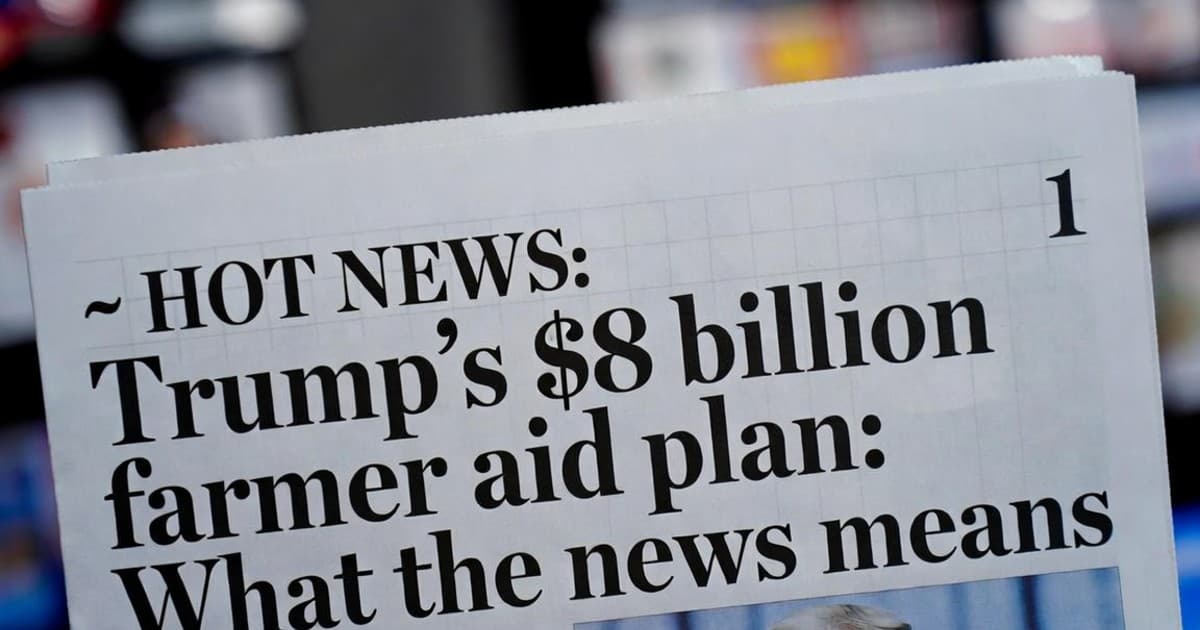
🚨 HOT NEWS: Trump’s $8 billion farmer aid plan: What the news means...
By The Daily Ledger6 min read155 views
President Trump announced an $8 billion aid package to support U.S. farmers facing soaring diesel prices and rising production costs. The plan follows an earlier $12 billion farmer aid package and a temporary easing of restrictions on red-dyed diesel use to help reduce fuel expenses. The measures aim to ease financial pressure on farmers and support agricultural production, although they may not fully offset rising costs or lower food prices.
Trump’s $8 billion farmer aid plan: What the news means The news is about the U.S. government planning additional financial support for farmers facing unusually high diesel fuel costs. Diesel is essential for operating tractors, combines, irrigation pumps, trucks and other agricultural equipment, so a sharp increase in fuel prices can make planting, harvesting and transporting crops significantly more expensive. The announcement also follows an earlier $12 billion farmer aid package and a policy change intended to make certain types of diesel fuel more accessible without federal fuel taxes.
- What exactly has Trump announced? $8 billion New Harvest Fuel Relief program Announced October 19, 2026 $12 billion Earlier Farmer Bridge Assistance Announced earlier in 2026 According to the U.S. Department of Agriculture (USDA), the new program will provide one-time payments to American farmers to help cover some of their losses and higher production expenses during the 2026 crop year. It will be administered by the USDA's Farm Service Agency. GovDelivery +1 The $8 billion is the total amount allocated for the program, not $8 billion for each farmer. How will the money be distributed?
- Payment calculations: The USDA plans to use a formula based on planted acreage, estimated production costs, crop yields and market prices.
- Partial relief: Payments are intended to cover a portion of estimated losses, not necessarily reimburse every dollar spent on diesel.
- Payment rates: The USDA says commodity-specific rates for certain major crops will be released in November. Details for other eligible commodities will follow.
- Applications: The USDA has encouraged eligible producers to prepare a Login.gov account linked to its systems so pre-filled applications can be made available when the application period is announced. The agency has not described this as a uniform payment of the same amount to every farmer. Diesel affects farming in several ways:
- Field operations: Tractors, combines and other heavy machinery consume large quantities of fuel.
- Harvesting: Farmers often need to operate equipment intensively during a limited harvest window.
- Transportation: Trucks use diesel to move crops to storage facilities, processing plants and markets.
- Profit margins: When fuel costs rise but crop selling prices do not rise proportionately, farmers keep less money from each harvest.
- Other expenses: Fuel price shocks can also raise freight costs for fertilizer, seeds, animal feed and other farm inputs. Reuters reported that farmers were facing record diesel prices during the 2026 harvest season and warned that persistent cost increases could put pressure on food prices. An example of the financial impact Consider a hypothetical farm using 10,000 gallons of diesel over a period of work. At $3.62 per gallon $36,200 At $6.53 per gallon $65,300 Additional fuel expense $29,100 This is an illustration, not an estimate of the average farmer's actual fuel consumption. It shows why even a temporary price spike can significantly affect farm finances.
- What is the red-dyed diesel policy? On October 5, 2026, Trump signed an executive order temporarily easing restrictions on using red-dyed diesel in highway vehicles. Red-dyed diesel is chemically similar to regular diesel, but the red dye identifies fuel generally intended for off-road uses, such as farming and construction. It is normally exempt from certain road-use fuel taxes. The order directs federal authorities to temporarily defer the federal excise tax on highway use of dyed diesel and coordinate with states on access and enforcement. Why does this matter?
- It can reduce the tax burden on eligible fuel use.
- It may provide short-term savings for farmers and truckers.
- It does not eliminate the underlying cost of purchasing diesel, which is also affected by supply and market prices. The USDA estimated that the dyed-diesel action could generate approximately $640 million in combined federal and state savings across about 224.6 million harvested acres.
- How do the three aid measures fit together? Measure Purpose $12 billion Farmer Bridge Assistance Earlier one-time support to farmers facing financial pressures. Red-dyed diesel executive order Temporary tax and enforcement relief intended to reduce fuel costs. $8 billion Harvest Fuel Relief New payments to offset a portion of modeled agricultural losses and higher production costs. The USDA says the earlier $12 billion program provided one-time payments to more than 560,000 farmers. The new $8 billion program is a separate initiative.
- Will this bring down food prices? Possibly indirectly, but there is no guarantee that grocery prices will fall. The chain of effects works like this: Higher diesel prices More expensive farming and freight Higher production costs Lower farm margins and more expensive transportation Potential pressure on food prices Some costs may eventually be passed to consumers Financial assistance can help farmers pay bills and sustain operations. However, it does not directly reduce global oil prices, fertilizer prices or every transportation expense. Reuters reported that produce, dairy and meat could be particularly exposed to higher transportation costs because these products often require refrigerated trucking. The effect on consumers may take time to appear. Reuters
- What are the political and economic implications? There are two important dimensions to this announcement.
Economic dimension: The administration is trying to provide short-term relief during a period of high input costs. The key question is whether payments and tax savings will be large enough to offset farmers' additional expenses.
Political dimension: The announcement came during a campaign rally in Kansas ahead of the November 2026 midterm elections. Reuters reported that rising living costs and pressure on agricultural communities have become political concerns for Republicans in farming states. Reuters +1 These political circumstances provide context for the timing of the announcement, but they do not by themselves establish the administration's motives. 7. What should farmers watch next? The most important practical details are:
- The USDA's announced payment rates for individual crops.
- The eligibility requirements and application opening date.
- How payments will be calculated for specialty crops and other commodities.
- Whether diesel prices ease enough to reduce operating expenses. The USDA's official announcement says commodity-specific rates for major eligible crops are expected in November 2026. Farmers can follow updates through the USDA's official Harvest Fuel Relief announcement. For further reporting, see the Reuters report on the $8 billion farmer aid program.
Bottom line: The $8 billion plan is designed to cushion farmers against a diesel-driven cost shock during harvest season. It combines with earlier financial assistance and temporary fuel-tax relief, but the actual benefit to each farmer will depend on eligibility, the payment formula and how long fuel prices remain elevated. It is a relief measure, not a guarantee that farm expenses or grocery prices will return to earlier levels.
##DonaldTrump #TrumpNews #BreakingNews #HotNews #USA #AmericanNews #5000Dollars #StimulusCheck #GovernmentNews #USNews #LatestNews #TrumpAnnouncement #AmericanCitizens #FinancialUpdate #NewsToday##Trump #LindsayClancy #PardonRequest #Mistrial #MurderTrial #Massachusetts #CourtNews #LegalNews #PostpartumPsychosis #CrimeNews #BreakingNews #USNews #TrialUpdate #Retrial #CurrentEvents##DonaldTrump #TrumpNews #BreakingNews #MidtermElections #2026Midterms #Republicans #GOP #MAGA #Election2026 #USPolitics #PoliticalNews #ElectionDay


Comments (0)
No comments yet. Be the first to share your thoughts.
Leave a comment
Comments are reviewed before they appear.