 Breaking News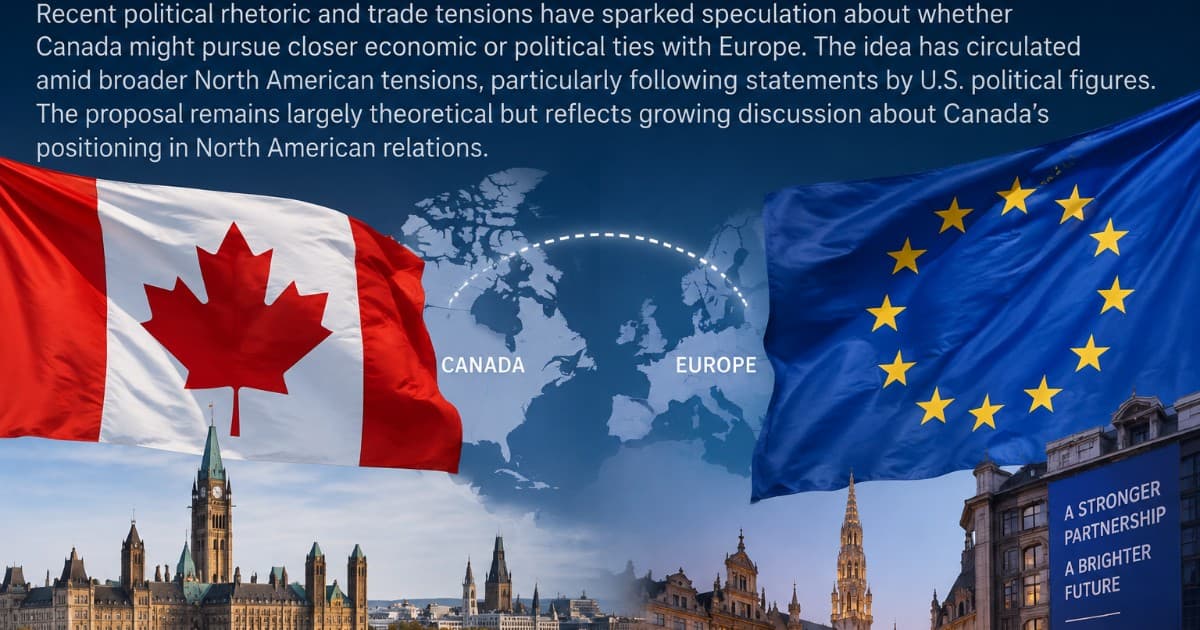
Breaking News
Could Canada Ever Join the European Union? Trade Tensions Fuel Debate
By The Daily Ledger2 min read7 views
Amid tensions in North American relations, questions about Canada's potential alignment with Europe have emerged in political discourse, though EU membership…
The notion of Canada joining the European Union has surfaced in recent political discussions, typically presented as a tongue-in-cheek response to trade tensions and evolving geopolitical relationships in North America. While such a prospect has captured attention in headlines and social media, serious examination reveals significant practical and institutional barriers that make EU membership for Canada virtually impossible.
The European Union functions as a complex supranational organization with specific membership requirements codified in EU law. Candidate nations must meet the Copenhagen Criteria, which include stable democracy, respect for human rights, a functioning market economy, and the ability to adopt the entire body of EU law and regulations. Beyond these political and economic standards, membership involves geographic considerations—the EU operates as a regional body centered on Europe, and Canada's location on the North American continent presents a fundamental structural mismatch.
Canada and Europe already maintain robust economic and political relationships through existing frameworks. The two regions conduct substantial bilateral trade, cooperate within NATO on security matters, and participate in various multilateral organizations. Canada has trade agreements with European nations and maintains diplomatic ties across the continent. These relationships are deep and consequential without requiring political union.
The recent discussion of hypothetical Canada-EU ties often reflects broader anxieties about North American trade relationships and political tensions. Rather than actual membership, experts point to the possibility of enhanced economic partnerships or deepened cooperation on specific sectors as more realistic scenarios. Some observers have suggested expanded trade arrangements or closer security coordination as alternatives to the implausible notion of full EU membership.
While the idea of Canada joining the EU makes for compelling conversation, it remains firmly in the realm of speculation. The two regions will likely continue building their relationships through the existing diplomatic, economic, and security frameworks that have long defined the transatlantic partnership. Any significant shifts in Canada's international alignment would more plausibly take shape through incremental trade arrangements or policy coordination rather than institutional restructuring.


Comments (0)
No comments yet. Be the first to share your thoughts.
Leave a comment
Comments are reviewed before they appear.