 Breaking News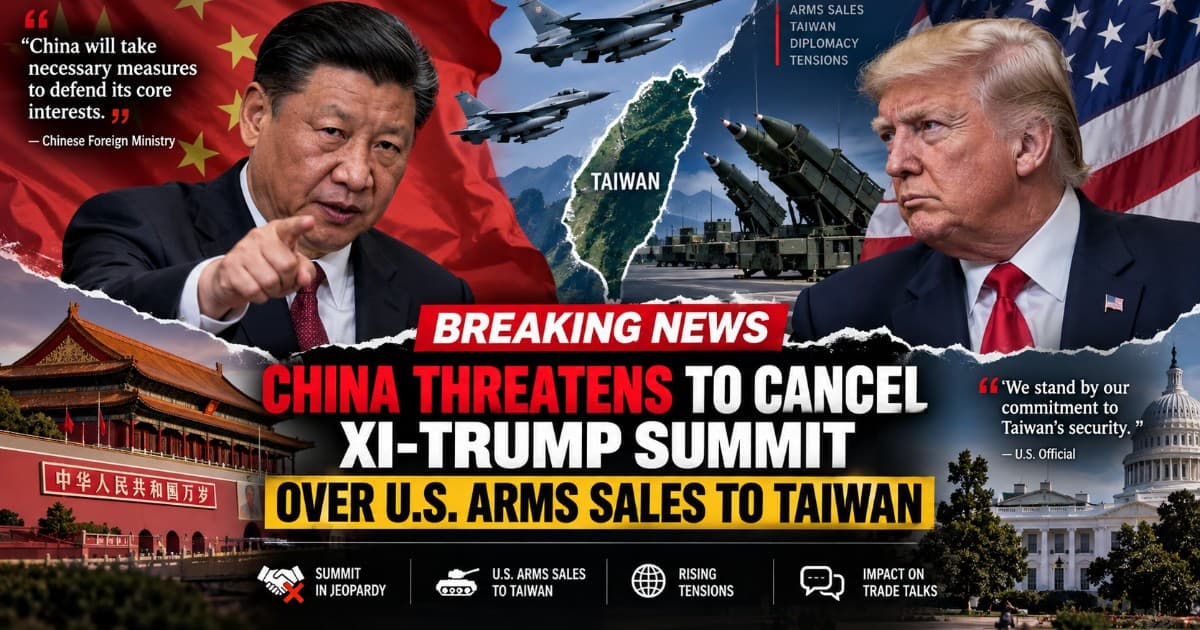
Breaking News
Beijing Warns Trump-Xi Meeting at Risk After U.S. Approves New Taiwan Arms Package
By The Daily Ledger2 min read10 views
China has threatened to cancel a high-level summit with President Trump after Washington approved a new arms sale to Taiwan, escalating tensions between the…
China Threatens to Cancel Trump-Xi Summit Over Taiwan Arms Sale
China has warned that a planned summit between President Donald Trump and Chinese leader Xi Jinping could be cancelled after Washington approved a new weapons package for Taiwan, injecting fresh turbulence into an already complicated relationship between the world's two largest economies.
Beijing's foreign ministry issued a sharp rebuke following the announcement of the arms sale, calling it a serious provocation and demanding the United States rescind the deal. Chinese officials framed the sale as a direct violation of the 'one China' principle, under which Beijing considers Taiwan a part of Chinese territory and opposes any foreign military support for the island's government.
The threatened cancellation raises the stakes considerably for both sides. A Trump-Xi summit had been anticipated as an opportunity to manage tensions across a wide range of contentious issues, including trade tariffs, the flow of fentanyl precursor chemicals, and geopolitical competition in the Indo-Pacific. Removing that diplomatic channel, even temporarily, would leave those disputes without a high-level forum for resolution.
The United States has sold arms to Taiwan for decades under the Taiwan Relations Act, the 1979 law that governs unofficial relations with Taipei and commits Washington to providing the island with the means to defend itself. Successive administrations, both Republican and Democratic, have approved such sales over Chinese objections, viewing them as a legal obligation and a cornerstone of deterrence in the Taiwan Strait.
This pattern means China's protests, while consistent, have rarely resulted in a permanent rupture of U.S.-China diplomacy. Analysts note that Beijing often responds to arms sales with strong rhetoric and temporary diplomatic gestures — such as suspending military-to-military talks — before eventually resuming engagement. Whether the threat to cancel a summit represents a genuine red line or a calibrated pressure tactic remains an open question.
For Taiwan, the arms package represents a continued effort to bolster its defensive capabilities at a time of heightened regional uncertainty. The island's government has long urged Washington to expedite weapons deliveries and approve more sophisticated systems, citing the military buildup across the strait.
In Washington, congressional support for Taiwan has grown substantially in recent years, making it politically difficult for the executive branch to delay or scale back arms sales in response to Chinese pressure. That domestic dynamic limits the flexibility available to the Trump administration even if it wished to use the arms sale as a negotiating chip.
The episode underscores how Taiwan remains the most volatile element in U.S.-China relations — capable of overshadowing trade talks, diplomatic summits, and broader efforts at stability with little warning. Whether Beijing follows through on its threat or uses the moment to extract concessions elsewhere will likely become clear in the days ahead.
#Climate


Comments (0)
No comments yet. Be the first to share your thoughts.
Leave a comment
Comments are reviewed before they appear.